
The British Council TeachingEnglish (TEBC) Webinar series can be found on the TEBC website. This is the link to Paul’s webinar that took place on the 19th May 2016. This is a summary of that webinar.
TEBC summarises the webinar thus:
“He [Paul] talked about the British Council’s CPD framework for teachers and different factors that can influence successful continuing professional development. This webinar explored some of the ways we can focus on our continuing professional development (CPD). We looked specifically at the British Council’s new CPD framework for teachers, the self-evaluation tool and resources on TeachingEnglish for professional development.”
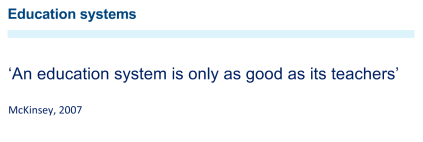
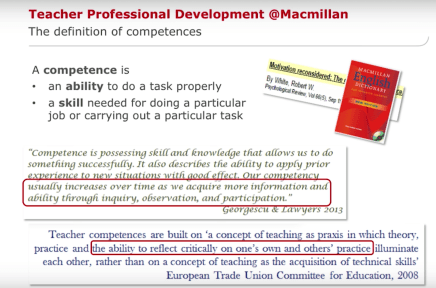
This is the quote that Paul Braddock starts us off with, one that is apparently much-used if you look on Google. However, it’s not as universally accepted as Paul thought before he read around it. The quote has been changed in the following way:
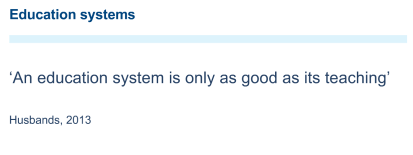
According to Paul, Husbands (2013) argues that what makes the most different to pupils is teaching. All teachers can be better but it’s teaching that improves and develops. Focusing on teaching focuses on more on the need to work continuously to improve the quality of teaching across schools. This is where CPD becomes essential. Especially as teaching changes and the skills needed change over time. What was a good teacher ten years ago might not be a good teacher now. Teaching needs to be develop.
Paul moves on to look at the 7 things that influence positive professional development, based on a report by Walter and Briggs (2012). What 7 things make professional development a positive thing for you?
Professional Development that makes the most difference to teachers is:
- concrete and classroom-based (looking at what teachers do in the classroom e.g. action research)
- brings in expertise from outside the school (Potentially expensive but expense can be kept down by use of webinars, online conferences, social media e.g. blogs)
- involves teachers in the choice of areas to develop and activities to undertake (includes using tools to help you identify your areas for CPD and this is where frameworks come in)
- enables them to work collaboratively with peers (physically within a context or with an online community of practice – requires time and space!)
- provides opportunities for mentoring or coaching (again, offline or online includes being a mentor or a coach as well not just being mentored/coached)
- is sustained over time (an action research cycle with the teacher him/herself as the focus)
- is supported by school leadership (so the school recognises it’s important despite budget cuts etc.)
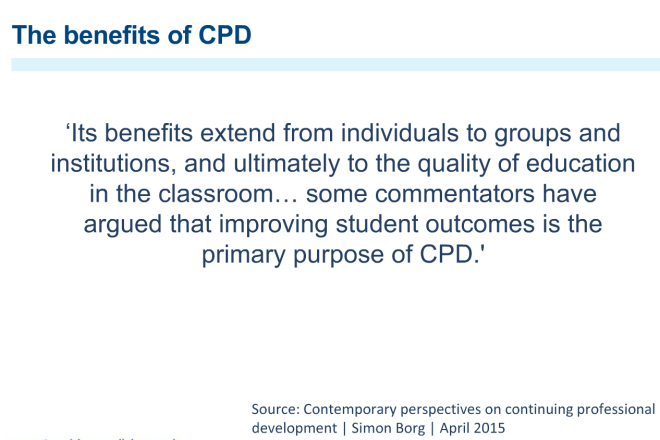
In other words, investment in CPD is useful and worth money.
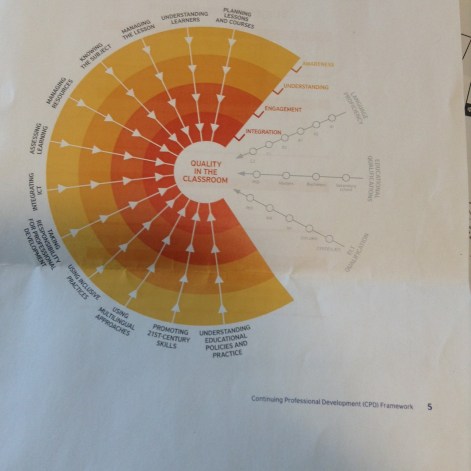
At this point, Paul introduces the British Council CPD framework:
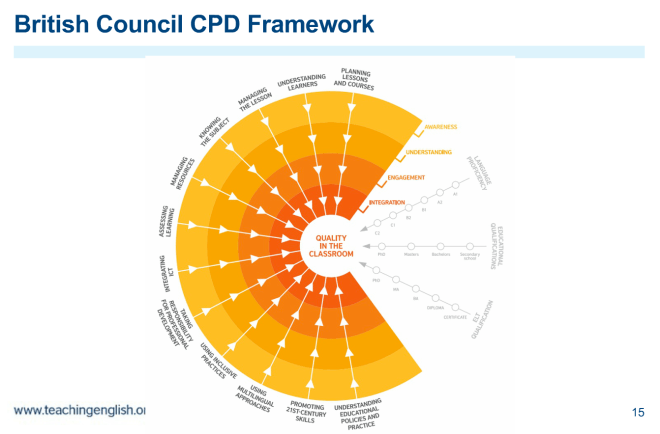
It is divided into 12 different aspects of professional practice:
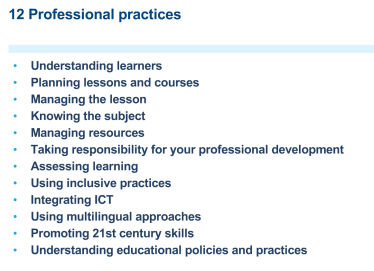
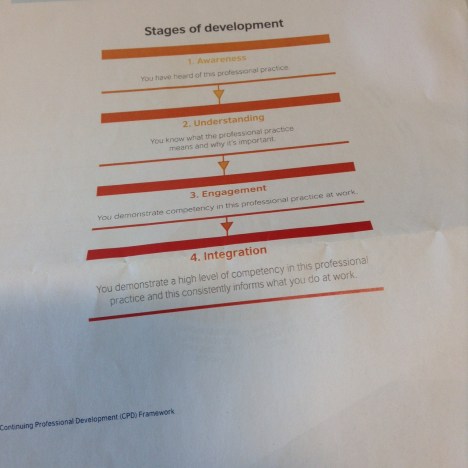
It is also colour coded by stages of development (Awareness, Understanding, Engagement, Integration). The BC was trying to address the misconception that CPD is linear. This is to be a tool that would more accurately reflect this. It is supposed to empower teachers by providing a framework for them to engage with CPD. Also to be used by groups of teachers for collaboration and cooperation. For more information about each professional practice see the document linked to above. He says it is designed to be flexible and teachers can change/adapt it to better fit their context. The process that you would go through is self-evaluation. The BC are currently developing a self-evaluation tool to help teachers decide which professional practice to focus on. At the integration level, this is where you’d then look at mentoring or coaching.
Next, Paul draws attention to the BC TeachingEnglish website. Within the Teacher Development tab, there is a section for Continuing Professional Development.
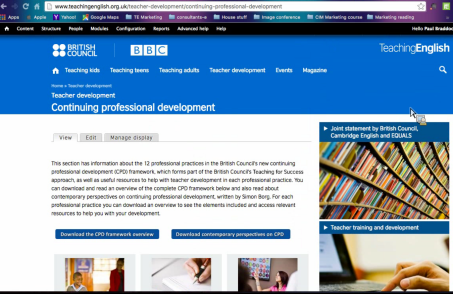
Here, you can find resources linked to each of the professional practices in the CPD framework – articles, blog posts, webinar recordings etc. (Fab! Look forward to exploring this!) The idea is, once you identify areas for your own development, you can use this site as a starting point for research, to support you in your journey. Click on the picture above to visit the page. This is an example of access to outside expertise!
TEBC also already offer out-of-the-box full courses such as Primary Essentials, TKT Essentials, Learning Technologies etc. These run for about 12 weeks, moderated or self-access. They are now thinking about how they can provide training that addresses aspects of the framework more closely. So, they have started to modularise the training, so by next April there will be the option of modules packaged into courses or individual modules you can follow (a module running for about 3hrs of study). This is so that you can bring in some training once you have identified which aspects within the framework that you want to develop.
From the 5th to 9th October, there will be an online conference run by TEBC too. (5th October is World Teacher Day!)
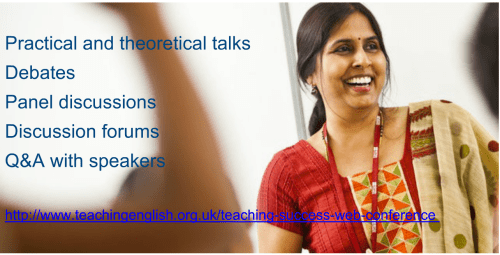
This CPD-focused conference is being launched to coincide with World Teachers Day. A date for our diaries! The picture above links to the link shown, for more information. This conference is free and aimed at teachers as well as teacher trainers. It will run from approx. 11 to approx. 4 UK time.
Paul also encourages us to investigate the following names in relation to CPD.
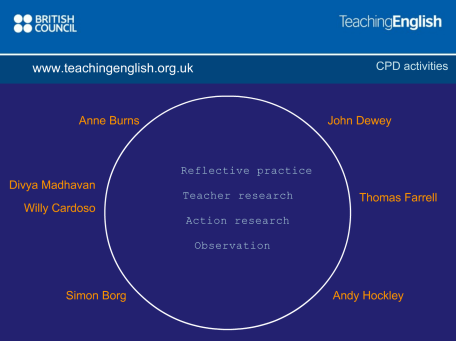
I’ll stick my neck out here and add Sandy Millin to the list! Her blog has a lot of useful content for developing teachers and also exemplifies reflection/reflective practice.
Here are the links provided by Paul finally:
NB: You can access the teacher educator framework from the English Agenda website, which is a sister website to TEBC.
It’s clear that a lot of thought and effort has gone into producing all these resources to help teachers develop – the frameworks, the accompanying resource curation on the TEBC website, the modularisation of the training courses that is to come. I certainly look forward to trying out a module without having to commit to a whole course. The abundance of resources available online for teachers looking to develop never ceases to amaze me and this is no exception. Thank you to the British Council and TEBC for doing their part in enabling this – by no means a small part.
Between discussions in the Teacher Education circle at work and watching IATEFL talk recordings such as the one by Kirsten Holt (courtesy of Macmillan) and the one by Shirley Norton/Karen Chambers (also made possible by the British Council!), I have been doing a lot of thinking about these teaching frameworks including the British Council one, so watching this webinar was the next logical step. I’m currently working on a few ideas of my own as to how teachers can use the British Council framework to develop, which should hopefully complement what’s already out there, so watch this space!
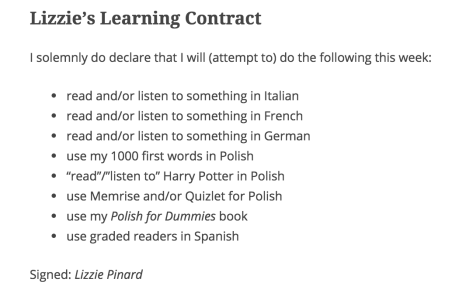
 This mostly happens in my lunch break at work. I have also watched the film of it along with a few others. In other Italian news, my diary writing continues to take place very nearly every day. Watching/reading in Italian is like slipping into a comfy pair of slippers and a cosy dressing gown: nice and relaxing!
 I also found an audio recording of it on YouTube, having failed to source it as an audiobook anywhere else! (Just an amateur version.) I have also dabbled in some Spanish Winnie the Pooh and have just started a new tv series (dubbed), again both via YouTube. No “learning activities” but I am enjoying it all! And Spanish is beginning to feel more familiar and less badly tuned.
 It took me a while to relocate (re-download from an online account where I had previously bought it) the e-book so initially I was just listening to the audio recording. I say listening, it was more just letting it wash over me and enjoying the sounds and rhythm. Around the 6th May (so a couple of weeks-ish in), my brain finally accepted Polish as a language rather than a random collection of sounds and letters with periodic spaces between them. To get to that point, I needed to use my Polish for Dummies book + notes I had made on pronunciation last year for some review, in combination with listening and reading along (once I got the e-book sorted) to Harry Potter. Since that point, I have started using Quizlet and am now up to 16 words/chunks on it!
  I haven’t, however, touched Memrise or my First 1000 words book. (To be honest I had forgotten that part of the contract – my brain was mostly focused on the reading/listening elements!) In YouTube world, like Spanish, I have also dabbled in some Winnie the Pooh…
  The main thing for me with Polish has been to relax and not worry about not understanding the majority of it when I listen to and read Harry Potter. Sometimes I work out what is being said, which is gratifying, sometimes the audio skips and I have to find where it’s gone, but I can do that now (which I struggled with in the beginning!) – it’s all about the minor victories!
 I haven’t used it an awful lot for languaging before, mostly because since I became interested in it, I’ve mostly been in places where Internet is limited i.e. you get a certain per month quota so streaming endless content on YouTube wasn’t an option. Now, however, with a fast and unlimited broadband connection, YouTube is one of my main go-to’s. That said, I’ve yet to find a ‘language learning video’ that I like. You know, the ones that are a video of someone teaching a piece of grammar or some vocabulary in your target language. If anyone knows any good Polish ones, though, please comment with a link!
 Some of the channels function rather better than others! So, my Italian channel, as far as reading/listening is concerned, is similar to my English channel in terms of comfort/understanding levels. My French channel isn’t far behind. My German channel was a lot more sub-functional initially but is getting easier all the time, the more I use it. That said, there is a definite difference in my understanding of Italian and French, and that of German. My Polish channel barely exists, but a channel has been made – “under construction”! Ditto the Spanish channel, except it borrows understanding from the Italian and French channels…
 YouTube clips of 8-10 minutes. Reading a few pages chapter while I’m eating my lunch etc. It’s all input! So I stand by what I’ve kept telling students over the years: doesn’t matter if it’s “only” ten minutes, way better ten minutes than nothing!
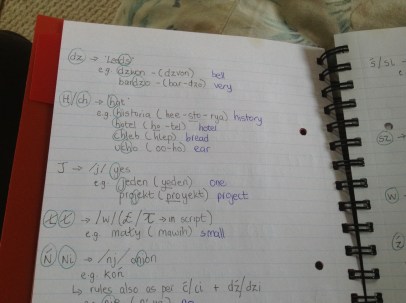 Need to work out what I want to use it for with the other languages. I suppose mostly I have just been enjoying input and haven’t needed a notebook for that… I also want use the lovely pack of coloured pens I treated myself to more – so far, again, just for Polish! (You can’t see it in the pic above but believe me, there has been purple, orange, pink, green… 🙂









 Lizzie Pinard