
(This post may seem somewhat counterintuitive at the end of a semester, just before the Christmas break, but I am looking ahead to our new January cohort who are beginning in the new year, which actually isn’t so very far away!)
I always love the first week of a new course. Our courses follow a blended approach with Semester 1 being 10 weeks at 6hrs of learning per week, divided up into 2 x 1hr online lessons and 2 x F2F lessons, and Semester 2 being 12 weeks at 5hrs of learning per week, divided up into 1 x 1hr online lesson and 2 x 2hr F2F lessons. In Lesson 1, we introduce the course, reviewing its structure, how they will be assessed and how to navigate the VLE (Blackboard). In Lesson 2, students attend a tech induction, to familiarise them with how to use Blackboard Collaborate (for the online lessons) and the Google Suite. In the 2 F2F lessons, students learn about the asynchronous learning content, including establishing the importance of it and guiding them through accessing it, and write a letter to the teacher introducing themselves. All remaining time in the F2F lessons is dedicated to getting to know you activities. There is one provided but teachers are free to use the time as they wish.
These are the activities that I always try to include in Week 1, together with an explanation of why:
In addition to the core content of the Week 1 lessons, there are some elements that always feature in my Week 1 lessons. Here they are:
- The name game: Like the shopping list game where items are added at every turn, but in this case the items are a student’s name and something they like. This is generally the first activity in the first F2F lesson.
Learning students’ names is hugely important in establishing a rapport with them and being able to interact with them as individuals. For me, the easiest way to achieve this is by playing the name game with them. This is because as well as supporting students when they can’t remember a name or a like here and there, I am constantly repeating the information in my mind along with them. A class’s worth of repetition really helps to get the names embedded in my brain. As well as allowing me to learn their names, they get to know each other’s names as well which is helpful in the process of becoming able to work together effectively.
- Focus on pair-work and group-work: This starts with a describe and draw activity where, in each pair of students, one student describes a picture that the other must draw without sight of it. The describing and drawing stage is followed by a brief evaluation, in groups, of what is produced and what is missed. Finally, students, in groups come up with a list rules for effective group work.
Pair and group-work are a core part of our lessons, but may not have been much of a feature in students’ previous learning. The describe, draw and evaluate portion of the activity is light-hearted and provides a low-stakes way to experience pair-work and group-work. It also provides inspiration for the following part in which students come up with their rules. These rules can be referred back to in subsequent lessons when students take part in pair-work and group-work activities. For neurodivergent students particularly, a clear understanding of what is expected in group-work, with rules to follow, can help to alleviate anxiety.
- Introducing Mindfulness meditation: I start this sequence by showing a still (see below – and click on the link if you’d like to watch the clip!) from a short youtube clip about mindfulness meditation and its benefits, and asking them what they think the video will be about. They then watch the video and make notes, which they use to answer two key questions: What are the benefits of mindfulness? Which of those benefits would be most useful for you? In the final part of the sequence, I show the students the wording of an example short mindfulness meditation and suggest we try it, with me saying the words. Afterwards I ask them how they feel and finish by suggesting that we start each F2F lesson by doing it.
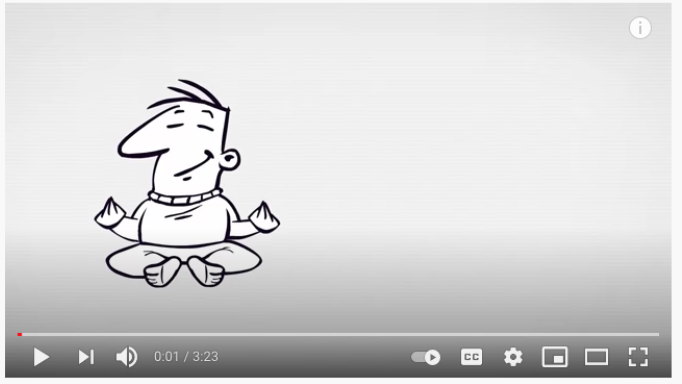
I have been using Mindfulness Meditation with students for some years now and remain convinced that it is beneficial for them. When they come into a lesson, their minds are all over the place – other lessons, assignment-related stress, workload, future plans etc – and doing a short guided meditation at the start of the lesson gives them a few moments of transition time, to really arrive in the lesson. Neurodivergent students particularly struggle with transitions so this is one way to make the switch from one lesson to another less abrupt and painful. The effect is always a class of students who go from being distracted by each other, their devices, their thoughts to being focused, calm and ready to learn. I introduce it the way I do (described above) to give them the opportunity to learn about and experience some of the potential benefits of meditation and evaluate which of those they would most benefit from, thereby turning it from being a random thing that is imposed on them to being something that they understand as beneficial to them. I do this in the first F2F lesson so that the second F2F lesson can already begin with it – start as we mean to go on! As we do the meditation at the start of every F2F lesson, it also becomes one of the many little routines which enable a secure, stable classroom environment for students.
- Focus on strategies for effective studying: “How can we study effectively?”: This is a simple activity – students work in groups (getting to practise using the group-work rules they have already established) to make a list of strategies. Then, after eliciting all of theirs, I share some of my own.
Students generally come up with ideas that centre around study-skills, time management, organisation, collaboration and the like. My list contains some of those but also focuses on wellbeing, so for example “take breaks”, “exercise”, “meditate”, “try to get plenty of sleep”, and psychology, for example “have a growth mindset” and “tell your teacher when you have a problem”. Each item is accompanied by a brief explanation. Students’ two semesters with us are going to be loaded and stress levels are likely to be high, so looking after themselves is critical to being able to study effectively.
- a speaking-focused icebreaker: this is less set in stone. My current go-to, though, is “Interview a classmate and then introduce them to the class”. Nothing spectacular, the task is scaffolded by a handout which guides students through question preparation and provides space for notes to be made during the interview. Students then use those notes to tell the class about the classmate they interviewed.
Speaking-focused icebreakers are useful for two key things: giving students the opportunity to learn more about one another (as well as me to learn more about them!), and giving me a reasonable starting idea of students’ speaking abilities. With the above-mentioned activity, I can listen in to their interviews to hear unprepared responses and then the feedback stage demonstrates what they can do with a bit of preparation and some notes. Of course I also get to learn a lot about them as people which is lovely. Happily, remembering it all isn’t critical because the “Letter to the teacher” activity which is part of the core content provides a similar swathe of information in written form. Both the speaking activity and the writing activity inform the initial RAG (Red Amber Green) rating we give students at the start of the course.
Why is Week 1 important?
Week 1 sets the tone for what is to follow. At the end of a good Week 1, you have a class who have started to mesh and who are prepared for what lies ahead. They know a bit about what is expected of them and a bit about what they can expect from your lessons. They feel positive, encouraged, comfortable, respected and this means their brains will be more open to learning. You also have a teacher who knows their students’ names and has started to get to know them as individuals, a rapport being built. These are the foundations of a successful course of study. Also, and I think you will agree, there is nothing like the excitement tinged with nervous anticipation of embarking on Week 1 and meeting your new group of students!
Over to you
What do you always do in the first week of a course with a new group of students? Why? Tell me all about your go-to activities for Week 1 using the comments function – I’d love to hear from you (well, read anyway!).
 Lizzie Pinard