
Delta Tips 4: Module 1, Paper 1

This is the fourth in a series of blog posts I’m doing in response to the number of Delta-related searches that bring visitors to my blog. Each post in this Delta Tips series will deal with a different element of the Delta, based on my experience of doing it (and surviving to tell the tale! ) at Leeds Met

The assessment for Module 1, as every Delta trainee is all too aware, is a 3hr exam. This consists of two papers, each one of which you are given 1.5hrs to complete, making 3hrs of hell in total. This post will focus on Paper 1. (For Paper 2, click hereFor a collection of links to resources that might help you with your revision, click here)

Paper 1 includes 5 tasks:

Tasks 1 and 2 deal with terminology. In Task 1, you are given six definitions, for each of which you must supply the correct term. In Task 2, you are given six terms and must give definitions and appropriate example for four of them.

Task 3 is an activity, for which you have to identify five features (type specified by the rubric) that learners at a particular level would need in order to complete the activity successfully. For each feature, you must give an example.

Task 4 is based on a piece of authentic material. You must firstly identify five features that are typical of the genre and include an example for each. Then, you will have 3 further questions focusing on a mixture of form, meaning and pronunciation of selected language from the text.

Task 5 requires you to analyse a piece of learner-produced text. This is usually written but can also be a transcript of spoken language. First, you have to identify 3 key strengths and 3 key weaknesses of the text, providing an example for each. Then, you have to select a weakness to prioritise, giving 3 reasons for your choice.

Here are my top tips for completing Paper 1 successfully:

Task 1

  • Study your A-Z of ELT by Scott Thornbury (if you haven’t got one – either buy it or beg/borrow/steal it from somebody!)
  • Only give one term per definition – if you aren’t sure and put two down, you will not gain the mark if one is correct. (Stands to reason – it’s not the examiner’s job to choose the correct term!)
  • Read a lot – of ELT-related stuff that is, cheap thrillers won’t help you here! – over an extended time period. Repeated exposure to terminology in action will probably help at least some of it sink in. This tip is no good the day before the exam, really!

Task 2

  • Structure your answer clearly. Use bullet points and make it obvious where your definition, further point and example are.

E.g. c. pragmatic competence

Def.: ability to interpret/use appropriately the illocutional meaning/function of an utterance

f.p.: Differs from culture to culture, so learners need to learn how to do this using the target language.

e.g.: “It’s cold in here” could be a request to shut the window.

  • Don’t forget your example or your further point, they are each worth a mark. Your definition will only score one mark.
  • In terms of revision, revise as for Task 1

Task 3

  • Read the rubric carefully: What level learners is the activity aimed at? What type of features are you asked to provide? E.g. “speaking subkills/features of discourse”
  • Lay out your answer clearly

E.g.

Feat.: Questioning others’ opinions

E.g.: “That’s interesting, but what about…”

  • Make sure the features and examples you give are suitable to the level of learner specified i.e. not too easy or too hard.
  • Mentally picture running the activity in class and think about how you’d prepare your learners and what things they might struggle without.

Task 4

For the identification of generic features:

  • Before you look at the text, look at the rubric and how the material is defined, e.g. “a human interest story from a popular newspaper”. Predict what features you might expect to see in such a text. Then look at the text and see how much of what you predicted is there.
  • Practice on any authentic material you can get your hands on – from leaflets to cereal packets.
  • Use  CLOGS to help you get a good spread of features. CLOGS stands for Content, Layout, Organisation, Grammar/Lexis, Style.
  • Check what the rubric specifies you include or do not include e.g. “You must include features of organisation and of language” or “Do not include more than one feature of layout” Make sure you follow these instructions! (Easy to forget in the heat of the moment…)
  • Give an example from the given text for each feature you identify.
  • If your mind goes blank, move on to the next question – this is only worth one mark per feature/example.

For the focus on form/meaning/pronunciation:

  • Use bullet points and break down your answer into as many bullet points as you can without being ridiculous. This will enable the marker to identify your points more easily.
  • Put down anything remotely relevant, no matter how simplistic. (Yes, you can get a mark for saying “you” is second person singular or “the” is a definite article.)
  • You can get the 35 marks allocated to this part of the task from any of the sub-questions (usually b, c and d), so play to your strengths.
  • Put down as many points as you can in time that you have. (Some may not be accepted according to those pesky guidelines answers, so having a few in reserve is never a bad plan!)
  • Use phonemic script for the pronunciation focus questions and think about features of connected speech. Also remember stress. (The sentence sort rather than the Arrrrrrrgh sort ;-))

Task 5

  • Use one piece of paper for strengths and one for weaknesses. That way, you can come back and add things if your mind goes blank and you feel the need to look at another question meanwhile. Label your pieces of paper “Strengths” and “Weaknesses” (not “Positives” and “Negatives” or any other variation)
  • Lay your answers out clearly:

E.g.

Weaknesses

Category: Accuracy of grammar

Explanation: Persistent misuse of present simple

E.g.: “only child never have to”

Effect on reader: may lower the reader’s opinion of the language/cognitive ability of the learner.

  • The “effect on reader” slot is to try and trap the few bonus marks that it is possible to gain in this question. You may or may not feel it worth it in terms of time management.
  • Read the rubric carefully. What level is the learner who produced the text? What areas are you asked to focus on? Highlight them and refer back to them; make sure your answer matches them.
  • When selecting your weakness to prioritise, consider the level of the learner, how pervasive the weakness is and how easy or otherwise it might be to fix it as well as the effect this would have on the learner’s production and on their reader/listener.
  • You must give reasons for your choice – the questions I just recommended you consider in selecting the weakness can become reasons.
  • Lay out your answer clearly:

E.g.

Weakness to Prioritise: Misuse of present simple

Reason 1: At this level, the learner shouldn’t be making this mistake and there is danger of fossilization if it is not attended to.

Reason 2: Prioritising this will enable positive transfer across other genres.

Reason 3: It will greatly increase the learner’s chances of success in exams or in finding a job.

  • There are bonus marks to be had if you include more detail in your reasons: a bare list of reasons gains 3 marks, adding more information can get an extra mark per reason. Whether or not you want to learn the tricks for the extra 3 marks is up to you!
  • Related to the above bullet point: study an Examiner’s report/guideline answers for this question – it is pretty formulaic (something that I gather is going to change when the exam is given an overhaul!) so learn the formula!

General tips for Paper 1:

  • Manage your time carefully: Don’t get bogged down by any of the questions. If you struggle with something, leave it and come back to it – you may find you can answer it when you’ve answered something else and, in doing so, calmed down. If you reach the recommended time limit (in brackets next to the task number), move on to the next task. You can always come back and fill in any gaps if you have time.
  • Do a past paper under exam conditions: This way you can make sure you know how fast you need to write and learn to manage your time. You can work out what order you prefer to do questions in. (If terminology panics you, don’t start with Task 1. Paper is unlimited so as long as you are using a sheet per answer and you hand in all your sheets, you are free in your choice of what order to work in. Doing a mock also gives your hand a chance to get used to extensive, high speed writing! (This is one of the good things about doing the Delta integrated with M.A. in ELT at Leeds Met – you do individual tasks and a complete mock paper to get M.A. accreditation, and that, together with the extra revision classes they chuck in prior to both the mock and the real exam, all becomes a valuable learning process for the real Delta exam! – Let’s just say, in that mock I learnt all about the importance of time management and remaining calm…!)
  • Look at examiners reports and guidelines answers: Cambridge are rather particular about what they want and how they want it – examiners reports and guidelines answers can shed some light on this!
  • Learn how to package your answers. My suggestions above for laying out the answers may seem like a faffy waste of time, but there is a good reason behind them: If you have learnt a framework for answering the question, then once you write down that framework, it focuses your mind on what is needed, meaning you are less likely to include superfluous information or omit essential information. Even if you don’t want to waste time writing down frameworks in the exam, having them in mind will still help you package the answers how Cambridge want them. Making a chart can help with getting your head around answer frameworks, mark allocation and so on.
  • Read the rubrics carefully and highlight essential information like learner levels, features to focus on etc.
  • Don’t write too much – use bullet points and keep them short.
  • Don’t forget to give examples where required

Delta module 1 is about what you know, but it’s also about exam technique and packaging what you know in a Delta marker-friendly way. So it’s definitely worth spending time on that as well as on revising terminology etc.

If you think I have left out anything essential, or simply have any helpful tips to add, please do so by commenting on this post. If you are embarking on Delta module 1, good luck – it is an interesting experience!! 
Delta Tips 3: Writing an LSA post-lesson reflection/evaluation

This is the third in a series of blog posts I’m doing in response to the number of Delta-related searches that bring visitors to my blog. Each post in this Delta Tips series will deal with a different element of the Delta, based on my experience of doing it (and surviving to tell the tale! ) at Leeds Met.

Having done your LSA assessed lesson (phew!), there is one more thing to do before you can call the LSA done and start afresh on the next one (or, when you reach that joyous moment after LSA4, celebrate not beginning all over again!) – The post-lesson reflection/evaluation. A mere 500 word limit is all you have to:

  • reflect on your planning and teaching as well as the learners’ progress
  • outline the strengths and weaknesses of the lesson (from the point of view of the learners)
  • identify how you might consolidate this lesson.

This is your opportunity to justify all deviations from the game plan (a.k.a. the spectacularly detailed LSA Lesson Plan) and demonstrate how aware you are as a teacher. 

Here are my top tips for writing  a post-lesson reflection/evaluation:

  • Before you start writing your reflection/evaluation, think about the aims/objectives stated on your lesson plan and whether you met them. If you did, what evidence is there of this? If you didn’t, why didn’t you? This might be useful information to include in your reflection/evaluation…
  • Think about how effective each stage of your lesson was, in terms of contributing to the learners’ progress.
  • Don’t do as I did in LSA1 and refer to a lesson stage using incorrect terminology! 😉
  • When you write about the key strengths and weaknesses of the lesson, remember these are from the point of view of the learner. For each one, think about what the effect on the learner was. If it’s difficult to pin down, then perhaps that is not a key strength/weakness.
  • Make sure you justify all deviations from your lesson plan. You are expected to teach the learners as well as the plan, so deviation is acceptable – however, it should be principled deviation. You should be able to rationalise your decisions.
  • When you consider how you might consolidate the lesson, don’t only think about completion of optional activities that you cut: think also about how you would develop the topic, the target language/skills and what other related, relevant target language/skills might connect nicely with what you’ve done.
  • Don’t be overly negative or overly positive. It’s easy to come out of the lesson with rather extreme feelings so be aware of that and don’t allow it to influence your writing too much. Your tutor/the examiner is unlikely to think it was either the best thing or the worst thing ever to happen. It probably wasn’t, though it might feel that way at the time. Remember that!
  • If you’re able to, talk the lesson through with someone you trust, before you write your reflection/evaluation. The act of talking it through may help you process what’s happened more effectively. Also, the thing you thought signified the end of the world as we know it may actually be quite minor – somebody less biased may help you realise this!
  • Ideally, write the reflection/evaluation on the same day as you did the lesson and then sleep on it. Check it over in the morning before you submit it and see if you still agree with what you’ve written. There’s nothing like a good night’s sleep to put things in perspective!
  • Remember, this is your opportunity to demonstrate what a self-aware, learner-aware, reflective practitioner you are – make the most of it!

If you think I have left out anything essential, or simply have any helpful tips to add, please do so by commenting on this post. If you are embarking on Delta module 2, good luck – it is a valuable learning experience!! 

Delta Tips 2: Writing an LSA lesson plan

This is the second in a new series of blog posts I’m doing in response to the number of Delta-related searches that bring visitors to my blog. Each post in this Delta Tips series will deal with a different element of the Delta, based on my experience of doing it at Leeds Met (and surviving to tell the tale! ) 

So, now you’ve written your background essay for your LSA (well done!) and sent a draft off for feedback (you know it makes sense!) – what next? Hopefully you still have plenty of time before your LSA assessed lesson, because this lesson plan is something else. Think of the longest, most detailed lesson plan you’ve ever written and then multiply that by 100 and you might just about start to get the slightest idea of what we are talking about here. Delta lesson plans are notorious – you will at some point fight the temptation to pull out clumps of hair (if you have any!) and you will need to allow yourself plenty of time to meet all the many, many requirements.

I was lucky – I did my Delta at Leeds Metropolitan and there, the tutors are nice enough to offer you a template to use as a framework for your lesson plan. If your centre doesn’t provide such luxuries, then I highly recommend making one. You can do this by using the criteria you have to meet for planning and preparation. (And no, I’m not going to upload the Leeds Met template – if you want it that badly, do your Delta at Leeds Met! 😉 )

In a Delta lesson plan, you need to demonstrate that you’ve thought of everything in great detail. For example (not an exhaustive list – like I said, look at the criteria…):

  • who’s in your class and the nature of the group
  • your aims and outcomes
  • what might go wrong
  • how you would fix what might go wrong
  • how this lesson relates to other lessons you’ve taught the class
  • a thorough analysis of your target language.
  • a rationale for what you are doing
  • the procedure you are going to use to teach whatever it is you are teaching.

Here are my top tips for writing a Delta lesson plan:

  • Make sure that whatever it is you decide to do in your lesson bears some relation to what you wrote about in your background essay. (You could think about using one of your teaching solutions.) Essay and lesson plan should cohere.
  • In your rationale, do NOT just repeat what you’ve written in your essay. The focus in your essay was broader – you were considering different types of learners and learning contexts, even if you had narrowed it by higher or lower levels of learners, whereas your lesson plan, and therefore your rationale, is for a specific group of learners.
  • For your target language/skills analysis, consider form, meaning and pronunciation. For skills, consider sub-skills and relate them specifically to your lesson – you don’t want it to be too general. You need to demonstrate your knowledge of what it is you are teaching.
  • When writing your procedure, think about how whatever activity it is you are planning is going to help your learners do something better.
  • Make sure your lesson aims and outcomes are clear and concise. Make sure they are suitable for whatever level it is you are teaching. Make sure they are achievable. Make sure they are measurable. Make sure they are not too vague.
  • Attach copies of all materials you intend to use and make sure you attribute them appropriately.
  • As with the essay, if you have a lovely tutor who is willing to give you feedback on your lesson plan (be it detailed, super useful written feedback as I had at Leeds Met, or a tutorial, which I have read in an EtP article also happens in some places), then submit a draft in good time. There will inevitably be something you haven’t thought of – your tutor will pick up on it and guide you to notice it.
  • Make sure your timings are realistic and remember things often take longer than you anticipate. Build in a contingency for if things do take longer – or indeed you get through everything too quickly. Make sure whatever activity it is that enables your learners to meet your aims and outcomes, so your main activity, is planned for early enough in the lesson that things taking longer than anticipated isn’t going to mean your learners are unable to finish that main activity.
  • Mentally rehearse the lesson – picture doing everything you’ve written down in your procedure, imagine how your learners might respond and how you could deal with those responses. (I did this while going out for a walk or a run; do whatever helps you think most fluidly.)
  • You will likely be nervous at the beginning of your assessed lesson – it can be handy to make that first activity something that the students can get on with rather than something teacher-fronted, so that the focus isn’t on you. That will give you time to get into your groove and relax, ready for whatever teacher-fronted activities you do have.

If you think I have left out anything essential, or simply have any helpful tips to add, please do so by commenting on this post. If you are embarking on Delta module 2, good luck – it is a valuable learning experience!! 

Delta Tips 1: Writing a background essay for an LSA

This is the first in a new series of blog posts I’m doing in response to the number of Delta-related searches that bring visitors to my blog.  Each post in this Delta Tips series will deal with a different element of the Delta, based on my experience of doing it (and surviving to tell the tale! ) at Leeds Met.

The LSA (Language Systems/Skills Assignment) background essay is the starting point for each LSA that you do to complete Module 2 of the Delta. You do 4 LSA’s in total, 3 of which are assessed internally and 1 of which (the final one) requires an external assessor. 2 LSA’s must be systems-based (Grammar, Discourse, Phonology, Lexis) and 2 must be skills-based (Reading, Writing, Speaking, Listening).

An LSA background essay is the synthesis of all your research relating to the specific area of the system or skill you have chosen to teach for your assessed lesson, and you are expected to cram a lot into your 2500 words Cambridge allows you. Each essay needs:

  • a clear, detailed analysis of the specific area you have chosen, with reference to a range of relevant literature
  • an analysis of the problems that may be faced by learners when a teacher teaches them this specific area, with reference to your experience as well as the literature.
  • a set of solutions to the afore-mentioned problems, each of which must be carefully evaluated and include reference to your experience.
  • a list of all references used in the essay
  • appendices containing copies of any materials referred to in your teaching solutions

Here are my top ten tips for writing a successful LSA background essay:

  • Read widely and relevantly (obviously…)
  • If the area you have chosen is rather large, use your title and introduction to narrow it down a little, for example by focusing it on higher or lower level learners.
  • Be concise (You may well find yourself re-reading and re-reading your essay, removing all phrasal verbs and non-essential articles!)
  • Make sure your structure is clear and easy to follow (the examiners won’t be your friend if you don’t!)  – You can use headings and sub-headings and numbering systems to help you with this. You need to make sure there is a clear link between your analysis of language/skill and your teaching solutions.
  • Make sure your language analysis takes meaning, form and pronunciation into consideration, while your skills analysis should include coverage of any relevant sub-skills and meaning/form/pronunciation analysis of any associated language, for example structural language related to telling anecdotes within a speaking skills essay.
  • Make sure your analysis of problems includes reference to a range of teaching contexts (different ages, levels, locations, L1’s etc)
  • Make sure you explicitly evaluate your teaching solutions, with reference to your own experience of using them. Phrases like “In my experience..” and “I have found this valuable because..” and “I have found this effective in…” are all useful!
  • If you are lucky, as I was, and you have a wonderful tutor who is willing to liberally cover your essay in feedback on how to make it meet Cambridge requirements, then make sure you submit a draft!
  • Related to 8. above, don’t spend too long reading before you start writing. You can always reopen books to fill in any gaps. This is particularly important for intensive courses, where time is tight and you need to manage it very carefully in order to get draft feedback and prepare your lesson plan (and get draft feedback on that!) prior to the assessed lesson.
  • Related to 8. and 9. above, don’t spend too long writing your LSA essay. You need enough time to fill in a ridiculously detailed lesson plan and hopefully get feedback on that too.

If you think I have left out anything essential, or simply have any helpful tips to add, please do so by commenting on this post. If you are embarking on Delta module 2, good luck – it is a valuable learning experience!! 

Dissertation Diary 1

I’ve decided to use my blog as a reflective tool while doing my dissertation project – the final part of my M.A. in ELT – hypothesising that this will make it an even more effective learning experience for me, by mapping it, enabling me to look back on my thought processes and decisions and see what effect these have on the project development. Once I get to the end (13th September is D-Day!), as well as looking back over the experience of doing the project, I plan to try and evaluate the effect of these reflective blog posts on it.

 My dissertation project will involve creating 20hrs worth of learning materials and a 5000-word rationale for these. The other option was to do a traditional research project of 10, 000 words, so electing a route to take was the first major decision. I’ve opted for materials development, not because I didn’t want to do research (au contraire, I think it would have been really cool to do a research project!), but because doing this reasonably substantial materials project under the guidance of a highly skilled, experienced supervisor should be a great opportunity to further develop those skills that I started to develop during my materials development module and that I hope to use in my post-course professional life.

I had my first post-proposal submission meeting with my supervisor (H) on Friday. When I went in, my thoughts regarding my project were very woolly. Truth be told, they are still pretty woolly but I now have a list of things I need to consider, a bunch of reading I need to do and a clearer idea of how to go about marshalling said woolly thoughts. So, quite a lot of progress for one meeting!

The first thing was to decide whether to do English for Academic Purposes (EAP) materials or General English (GE) materials, as initially I had decided on GE materials but then, since submitting my proposal, had the idea that making EAP materials might be beneficial in terms of compensating slightly for a lack of EAP teaching experience when I come to apply for EAP jobs (my goal…). We discussed the advantages of doing each and through that I came to the decision that perhaps making good quality, principled materials is the main thing, regardless of type. If I’m able to do that, then when I’ve got some EAP experience, I should be able to transfer that skill to making EAP materials if the need/opportunity arises. Meanwhile, I will read up on EAP and learn what I can about it. H also suggested observing a few classes, which I will definitely look into the possibility of doing. Of course, a major benefit of making GE materials is that, as I will be teaching GE part-time over the summer, there may be the opportunity to pilot what I create, which would be very useful.

Having settled on GE, a whole new set of considerations and decisions to make emerge:

  • Will my materials integrate all four skills, like a standard coursebook, or focus on specific skills?
  • What type of teachers are the materials being made for? This will influence what goes into the teachers’ book and how ‘adventurous’ the materials themselves are – as the more adventurous they are, the more experience might perhaps be required of the teacher in using them. (An important factor to think about in designing materials.)
  • What approaches will I use in the materials? Using two approaches, would I go with using both at slight separate times in the unit, depending on the language point or stage in the unit, or combine them? Will combining them work? Will I take a particular approach and select certain aspects but not others? What would be my rationale for these decisions?

I need to be clear about what the approaches are saying and then what my approach to those things is going to be – I don’t necessarily have to go along with every single element of a given approach in my materials. I can synthesize, adapt and change things, but I must think about what it is I am changing and why, and be able justify those decisions in the rationale.

H suggested that a good place to start could be to look at the approaches, have a really good think about each one that I might possibly want to use in my materials, (re)read up on them and decide which to use. From a practical point of view, I need to be selective: The more approaches I try to combine, the more unwieldy it becomes, the more difficult to give each one enough focus, and the more there is to justify in the 5000 word rationale. Not impossible, but it is more straightforward to choose fewer.

I need to think about the theory but then in the back of my mind also be thinking about the project and about how it’s going to work with my context, and which of the theories are going to be workable in the kind of materials that I want to develop.

More questions that were raised and that I need to answer:

  • What is going to be original about my materials?
  • Will the materials be the basis for the main bit of teaching in the day (G.E.), which case all systems and skills will need to be addressed (unless the rationale contains a very good reason for why not!), or the ‘afternoon slot’ i.e. materials for a more specialist focus e.g. pronunciation or speaking.
  • Intercultural skills: will it be comparison between one culture and another or developing intercultural communicative competence? If culture is going to be a feature of my materials, I need to do some reading around culture and decide where I stand on the various different questions around what we do with culture. Everything is potentially offensive: including content about different cultures can offend people or seem stereotypical. But then it’s needed to get interesting content and it’s an important thing to help learners with.
  • Criticality: Why would I want to develop criticality on a G.E. course? More usual for academic courses. If doing it on a G.E. course, need a rationale for it.
  • What sort of format will the multimedia take?  (There’s no obligation to use any particular format.)

To do for next meeting (before the end of June):

  • Start by doing some reading
  • Put together an outline of the rationale. (Headings and notes) that can be used for the basis of discussion in the next meeting.
  • At the same time, develop a skeleton framework for the materials – framework of a unit, a list of what it will constitute – then the two can be looked at in conjunction. It would help if they relate… 😉

Aim: ideas for rationale and materials need to be more firmed up.

So, all in all, I have a lot of reading to do, a lot to think about and a lot of decisions to make. But that will start to happen post-5th June (Delta Module 1 exam, preceded by final semester 2 deadline on the 3rd). Until then, all of these questions and thoughts will just keep percolating away in the back of my head…

Part 2 – Coming to the end of my M.A. in ELT: Taking stock.

This is part 2 of my reflections about my experience of doing the M.A. in ELT at Leeds Metropolitan University. Part 1 deals with the Delta component of the course, and came about as a guest blog for Sandy Millin. You can read it on her blog, along with all the other respondents’ posts. Coming to the end of my M.A. in ELT: Taking stock. Classes are all but over, The assignments all but in, Time to say goodbye now But what a year it’s been! It’s been nearly a year since I applied to do my M.A. in ELT at Leeds Met. I distinctly remember getting to the end of the interview and being offered a place on the course – and then once the euphoria wore off using the next month to read everything ELT-related that I could get my hands on in preparation. But in between, I had to officially accept the offer, through an electronic system, and before I made that step of committing to giving up a year of my life and a fair old sum of money, I was intensely anxious. I hadn’t even heard of Leeds Met until I found the leaflet for the course in my conference pack at IATEFL 2012! What if it was totally shoddy? I was somewhat reassured by the universality of the Delta qualification element and also by the years of experience I discovered the tutors had when I nosed around the official Leeds Met site and located the profiles which mentioned the Delta and the M.A, and so it was I accepted my offer. And, without a doubt, professionally it’s been one of the best things I ever did. Coming to the end, and having had such a great experience on the course, I decided I wanted to write about it for my blog, so that anybody either in a similar position to the one I was in – about to accept and wanting reassurance that the decision wasn’t going to be a huge mistake – or in the position of choosing between various professional development options, could read it and use the information to help the decision-making process along. There are two main routes that exist for the M.A. in ELT: The first one, which I did, integrates the Delta into it, while the second one doesn’t. There are also part-time and full-time options – I did the full-time one – and an online version. My focus will, of course be my route, full-time M.A. in ELT with integrated Delta. In order to try and minimize the rambling, I will borrow from the set of questions used in Sandy’s Delta Conversations idea, and which I answered for the Delta component of this course. So here it is, my experience of the M.A. in ELT at Leeds Met: 1. Why did you choose this M.A.?  Mostly because of the integrated Delta. I was very keen to upgrade my CELTA and generally make myself more employable. Doing the M.A. at the same time seemed like an added bonus! 2. What do you think you gained from doing this M.A.?  What didn’t I gain?! To try and be more specific, then:

  •  The opportunity to develop a range of skills that I will be able to apply beyond the end of the course. So, for example, materials development, multimedia tool development, course development (this came through the Delta Module 3 element but the M.A. assessment, which reflected the Delta assignment, helped me process the whole thing in greater depth), how to do research, how to write a journal article, how to give good oral presentations. I had experience of none of these prior to the course, except for materials development and my experience of that was fairly minimal. So it was a steep learning curve, but coming out the other end, a lot doors have opened up to me. For example, I am going to be presenting at two conferences over the summer. At the first (The Warwick Applied Linguistics Conference in June) I will be presenting the research I did for the research module and at the second (the MATSDA conference in July), I will be presenting a sample of the work that I and my colleagues produced for the materials development module and discussing it in relation to the conference theme. Further into the future, I look forward to doing more research, developing more materials, writing journal articles for publication, being involved in course design, presenting at more conferences, and so on. I feel that a lot of doors have opened up to me through doing the course.
  • A great deal more self-confidence than I had before, through discovering my “voice”.  When I started the course, it quickly became apparent, in initial drafts of Delta Module 2 LSA1 and my Delta module 3 essay introduction, that this was something I lacked. This relates to the development of critical thinking skills, which is a very strong feature of this course, and the opportunity and guidance in this area of development contributed to the emergence of my “voice”.
  • Awareness of the limitations of what I know as well as the ability to question everything and look for answers, both in the literature and through primary research of my own.

 3. What were the benefits of doing an M.A. in ELT at Leeds Met?  Well, having the opportunity to gain everything that I gained, as described above, for a start! In addition:

  • A distinct benefit of doing this course is learning from the fantastic team of tutors who deliver it. They are all very experienced in their specialist areas and enthusiastic about sharing that experience and knowledge with the cohort. I have also found them all very supportive and helpful in every way.
  • The group was nice and small, but not too small, and very diverse. This meant that as well as being close-knit and supportive, there were enough differing opinions to make for a wealth of stimulating discussion in class.
  • Related to the above point, all the opportunity for discussion built in to all of the modules, so that as well as benefitting from the tutors’ knowledge, we also gained from the range of different experiences that we, the cohort, have had between us.
  • The assessment strategy is brilliant. Each assessment type is very practical and you learn through doing it rather than simply being assessed. Of course, what you learn is also directly applicable beyond the end of the course.
  • The opportunity to try everything out (by “everything”, I mean all the skills described in my answer to question 2 above) and be helped to learn how to do it all properly, in a supportive, scaffolded environment, and so being prepared to go off and do it all independently and hopefully develop my career.

4. What were the drawbacks of doing an M.A. in ELT at Leeds Met?  There weren’t any! I’ve loved every minute of it. 5. What tips would you give other people who plan to do an M.A. (possibly at Leeds Met!)?

  1. The only limiting factor to what you can get out of the experience is what you put in. The more you put in, the more you get out.
  2. Be prepared to work and work and work and work…you get the point. It’s an all-consuming experience but that does make it incredibly rewarding too.
  3. Don’t be afraid to ask for help when you need it. The support is there. (I would hope this would be the same at other universities but of course I can only speak for the one I attended!)
  4. Read as much as you can before you start the course, especially if you are doing the integrated Delta: There aren’t enough hours in two semesters to start from scratch and read enough to maximize on the experience. Once you start doing the course, read cleverly: Make notes of where you’ve read stuff, target your reading carefully etc.
  5. Get drafts done in advance of assignment tutorials – you can benefit much more fully from these if the tutors have seen something beforehand.
  6.  Enjoy it!! It’s an amazing experience and it comes to an end all too quickly.

Well, this post is far too long already so I shall bring it to a close now. If you have any questions about the course, contact Heather Buchanan (course leader) on h.buchanan@leedsbeckett.ac.uk; if you have any specific questions you want to ask me about my experience of the course, that aren’t answered above, feel free to get in touch – lizzie.pinard@gmail.com. Disclaimer: This blog post consists of my experience, my views and claims to be no more and no less!

Part 1 – Delta Conversations: (Repost of my Guest Post on Sandy Millin’s Blog)

Sandy invited me to answer a set of questions about my Delta experience, for inclusion on her blog along with other Delta teachers’ answers, to create a sort of guide for teachers who are thinking about doing the Delta and are not sure about how or where to do it. Having done this, I decided to adapt the set of questions and write a post about my M.A. in ELT, which had the Delta integrated into it. If you have any further questions about my experience or about what I’ve written below, feel free to comment or email me and ask – I’ll be happy to answer.

1. How did you do your Delta?

I did my Delta as part of a full time M.A. at Leeds Metropolitan University. This course integrates the Delta modules into an M.A. in English Language Teaching. However, at Leeds Met you don’t have to do the M.A. in order to do the Delta (or vice versa for that matter!), and you don’t have to do it full time either. If you only want to do the Delta, you join for Semester 1 of the M.A., which starts in September. As it is fully integrated, this route would still give you a Postgraduate Certificate in English Language Teaching and Professional Practice from Leeds Met as well as your Delta. You gain the Postgraduate Certificate or M.A. credits by doing Leeds Met assessments as well as the Delta assessments. However, this isn’t as bad as it might sound!

  • Module 1: you do a series of homework tasks, which help you learn how to do Delta module 1 Exam paper questions and these provide 50% of the Leeds Met module 1 credits. Then at the end of the semester you do a Delta Module 1 exam paper. This gives you the other 50% of the credits necessary for the Leeds Met module but also acts as a mock exam for the real Delta exam.
  • Module 2: you submit a portfolio consisting of your Delta module 2 work (LSA essays, lesson plans, PDA) and observation tasks. Leeds Met provides a set of observation tasks as guidance, but you are also free to create your own, tailored to your PDA. These are graded against Leeds Met criteria.
  • Module 3: you do an oral presentation based on your Delta module 3 extended specialism essay. People generally found that this really helped them get their head around their specialism and made completing the Delta essay much easier.

If you choose to do the Delta part-time, you do Modules 1 and 3 one year and then module 2 the following September. The teaching lasts for 12 weeks, and then there are two assessment weeks, the sum of which is the duration of the university’s semester 1.

 2. Why did you choose to do it that way?

I chose to do it this way because I found a leaflet advertising the course in my conference pack at IATEFL and it looked perfect for someone like me who had faffed around a lot in my twenties before discovering teaching and the CELTA. I wanted to gain two of the most highly sought after qualifications in ELT in one go – saving time in the long run and equipping myself, hopefully, to get a stable, permanent job. (That is the plan! I am just coming out of the end of the course, only got a dissertation to go, and am optimistic about the future! Starting with a couple of conference presentations based on work I’ve done for the M.A. portion of the course. It won’t happen immediately but it is now possible and that is distinct progress!) I had thought about doing Distance Delta before but then relocated to the UK, decided I’d rather do it face-to-face style and happened on that leaflet. Fate! In hindsight, I think I would not have coped with Distance Delta, as the whole course was a very steep learning curve for me so I found all the support I had from tutors and classmates absolutely invaluable and don’t think I could have got through without it! We were very much in it together and got through it together.

3. What do you think you gained from doing the Delta?

  • I think the most important thing I gained from doing the Delta is learning how to keep learning. That is, how to be a reflective teacher, how to develop my teaching through research, experimentation and reflection.
  • Also, I learnt how to approach a lesson in a principled, systematic yet flexible way. I would also say that doing the Delta helped my classroom practice to line up more closely with my teaching beliefs.

4. What were the downsides of the method you chose?

I don’t think there were any downsides, to be honest! I suppose, yes, it was incredibly intensive, intense and hard work, but those were good things too. Being completely immersed in Delta for a semester was immense. You have to be ready to put real life on hold for the duration, pretty much, and just work like a demon but it’s an incredibly rewarding experience. I suppose unless you are doing it part-time, you can’t work at the same time, so there’s a financial factor there. Worth it if you can manage it though.

5. What were the benefits of the method you chose?

The benefits? Where to start…

  • One thing I really liked about this course was the way the input sessions were carefully planned so that learning from each module fed into the other two modules too.  For this reason I’d recommend doing all three modules in one go. (I don’t know how intensive courses work elsewhere but I think the Leeds Met way definitely works!)
  • A very important aspect, for me, was all the tutor support I received: LSA1 was a very steep learning curve for me, but my tutor helped me understand what was expected in terms of the essay and the lesson plan, by giving me incredibly detailed and helpful feedback on my drafts. I then managed to scrape a pass in both essay and lesson plan. Following the assessment, we had individual tutorials to get our feedback, which again were very thorough and helpful, and given very supportively. And this, together with similarly helpful feedback on future drafts, enabled me to go from scraping a pass in LSA1 to getting a distinction for my essay and a merit for my lesson in LSA2 and 3. Also, I didn’t realize at the time that it wasn’t standard, until Sandy sent me an LSA lesson plan of hers to look at, but Leeds Met very helpfully provide a template for the lesson plan, which is very helpful in guiding you to meet all the criteria. It sounds like a small thing but every little helps when you are starting off and don’t have a clue what you are doing!!
  • Doing the Delta intensively is a mental and emotional rollercoaster, but the tutors understand that and help you through it. For example, with Module 3, another near-vertical learning curve for me, there was a point just before we got our needs analysis tools back, having previously submitted them for feedback, where I lost all confidence in myself and emailed my tutor saying I was convinced I was going to fail this module and so on, pretty much ready to give up on it, and very quickly had the very reassuring response that I needed to be able to keep going as well as all the support I needed to get to grips with what was required. Module 3 was very well managed actually: we had mini-deadlines throughout the semester, where we submitted drafts of each section of the extended specialism essay and received feedback on those, as well as individual tutorials. I was able to go from not having a clue at the beginning to producing a completed assignment by the end, in structured, well-scaffolded little steps.
  • The camaraderie of the cohort shouldn’t be underestimated either. Having regular contact with a small but close-knit bunch of classmates going through the same thing as you is one of the great things about face-to-face Delta. We jollied each other along, whinged to each other, helped each other, gave each other kicks when necessary and so on.

6. What tips would you give other people doing the Delta?

Top tips from me would be:

  1. Read as much as you can before you start the course.
  2. Do the course somewhere, like Leeds Met, with lots of support built in for all the wobbly moments and a course that seems designed to maximize on the learning potential of all modules.
  3. …Or just do it at Leeds Met!
  4. Read my blog post of top tips for Delta trainees!!
  5. Don’t forget to enjoy it – it’s an amazing opportunity so get as much out of it as you can.

If you have any questions about the course, contact Heather Buchanan (course leader) on h.buchanan@leedsbeckett.ac.uk; if you have any specific questions you want to ask me about my experience of the course, that aren’t answered above, feel free to get in touch – lizzie.pinard@gmail.com.

Disclaimer: This blog post consists of my experience, my views and claims to be no more and no less!


Materials Development – What is it that makes learning materials better than good?

This subject is uppermost on my mind at the moment, as the final lesson of my materials development module will be this Friday. Next Friday, we will be doing “Dragon’s Den” presentations, where we have to speak persuasively for 12 minutes justifying and “selling” the materials we have been designing for the module assessment. Hopefully our materials will be principled, workable, suited to the chosen context and we will show evidence of the application of theory to practice – with a splash of creativity thrown in!

The materials I designed are aimed at upper intermediate students studying at private language schools in the U.K. It’s been an interesting and rewarding experience developing them from random sparks of ideas into a coherent 6-8 hour unit. I do like the idea of the module assessment being something which is not only practical and will be useful in the long run but also generates learning rather than simply testing it. The group has had 3hrs a week of input for the module this semester, in which we’ve systematically worked through different aspects of materials design from picking out theories of language, learning, acquisition and teaching,  principles in existing materials and identifying what theories and principles we believe in, to evaluating and adapting materials for a particular context, and looking at things like visual impact, clarity of instructions, how to integrate effective systems and skills development into materials, as well as issues such as how to develop intercultural competence. I expect I’ve probably left something out, but I’m sure you get the general idea.

Anyway, my question for anybody out there who happens to find this page is this:

What, in your opinion, separates the wheat from the chaff as far as materials are concerned?

What principles/theories etc influence your materials writing or teaching the most? 

And finally, How important do you think enjoyment is to language learning and why?

I shall post my presentation/powerpoint on here after I’ve delivered it, which will provide a good idea of my own views, but meanwhile what about all of yours? I’d be very interested to hear.

Feel free to answer as few or as many of the questions as you like – any and all responses are welcome!

Delta Module 1 Wall Chart for Revision

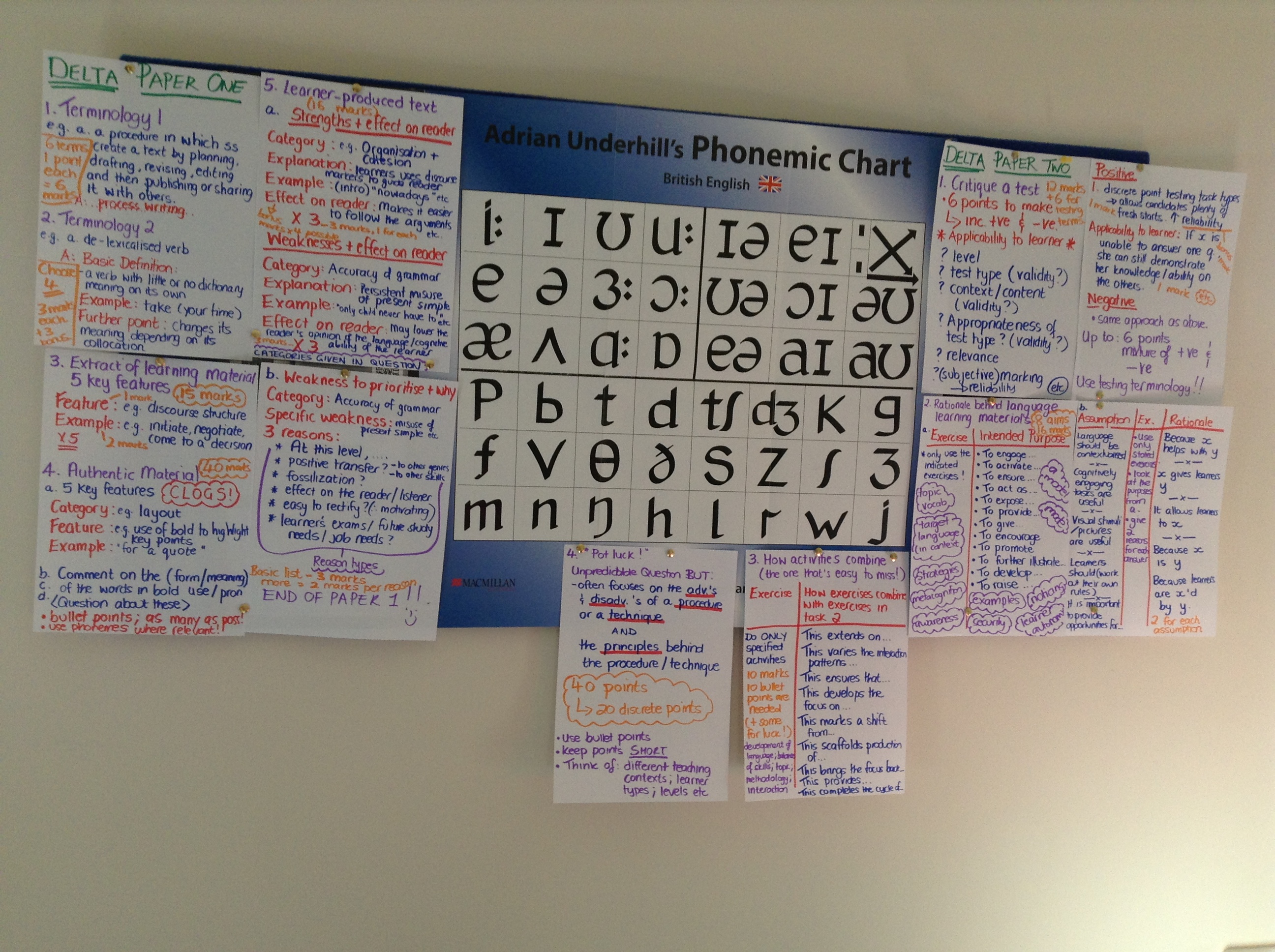
In just over a month’s time, I will be amongst those lucky teachers who will be spending 3hrs frantically writing, full speed, trying to package all the information just exactly how the examiners want it. Yep, the Delta Module 1 exam is getting nearer.

So far, my revision has consisted of creating this handy tool:

photo

Delta Module 1 Wall Chart

I can’t take credit for the phonemic chart, that of course belongs to Adrian Underhill. The map of the Delta exam, however, is miiiine. I have done absurd amounts of reading for my M.A. modules, so between that and the Delta Module 1 input I had last semester, which was nicely reinforced by the Delta Module 2 and 3 input in the same time period, so I am hoping that the key to this exam will be packaging the information the way the examiners want it. And so the wall chart was born. It is a synthesis of all the exam technique tips we discovered in the input sessions and through doing practice tasks, as well as the multiple examiners reports we received.

If nothing else, it was a good excuse to get the coloured pens out! Hopefully, though, having it stare at me for the next month will help on exam day. Time will tell!

The DELTA/M.A. treadmill! An update…

It would seem that I have not written a post since the 30th June this year! WordPress has gone and changed everything around since I was last here – I can’t say I’m desperately impressed with the changes but there we are – and I feel rather a stranger to the blogosphere.

In my last post, I described my euphoria in gaining a place on a DELTA/M.A. course at Leeds Met University, that I had discovered through picking up a leaflet at IATEFL. Since the 17th September, I’ve had a full time place on this DELTA treadmill and every last shred of energy has gone in to producing mountains of work to meet the flood of deadlines that was unleashed upon us from the get go!

Today I have finally emerged from the DELTA bubble. I haven’t quite finished it BUT I am, at last, getting off the treadmill momentarily and drawing breath. So, I thought I would share my thoughts on my experience so far…

1. DELTA is hard.

2. DELTA is hard.

3. DELTA is hard.

4. DELTA is hard.

Ok, ok, ok…I’ll get serious now…

1. If you sign up for a DELTA, do yourself a favour: do a ton of reading before the course starts. Take it from me, it *really* helps. Also, learn the phonemic alphabet. (I recommend Sound Foundations by Adrian Underhill or if you aren’t a reader – in which case God help you on the DELTA – this presentation of his on youtube is a winner! )

2. When your tutors tell you how to structure an L.S.A. (Language Systems Assignment/Language Skills Assignment, assessment for DELTA module 2), listen to them… Don’t try and be a clever Maverick. You will just have to redraft the essay to make it as you should have written it in the first place! (Ahem…)

3. The P.D.A. (Personal Development Assignment, another part of the assessment for Module 2) is “only” a pass/fail document. Do not be fooled by this into thinking that it is not important/can be put on the back burner: It is, in fact, key to your development as a teacher. The more you put into it, the more you will get out and the more you will improve between LSAs.

4. The E.P. (Experimental Practice) is part of the P.D.A. and equally important: If you follow the process fully, it trains you in the research – experimentation – evaluation cycle that is necessary for the P.D.A. Of course, in the P.D.A. you don’t need to produce an essay or Delta lesson plan, but the process of reading up on things, trying them out and reflecting on how it went is one that should be repeated as many times as possible throughout the course – and theoretically beyond too.

5. When preparing an L.S.A., don’t procrastinate. Do the reading, draft the essay, draft the lesson plan. Then go back and use any remaining time to hone. You will need it.

– If you do the Leeds Met course, make use of the drafting process: Between them, the tutors probably have nearing a century of experience to your (in my case) 2.5. They are willing to take your draft and liberally cover it with comments (feedback) on what is needed to bring it up to standard, *if* you submit it. Conclusion: don’t be a fool, submit it!

– If you do your DELTA anywhere else, make sure you find out what the procedure is, what help is available to you and make use of it!

6. Keep up with all the deadlines. *Including* those relating to Module 3, which it may be tempting to back burn in favour of working on your LSAs. They may seem like utter bastards but they are there to help you not end up with the worlds supply of work breaking over you in a big wave in the last week of the course. Even if you keep them, there is still *plenty* to be getting on with, don’t worry… (Where I’m at now…)

7. Make sure you *really* WANT to do the DELTA before you start doing it. You are going to live, eat, breathe, sleep it for 2-3 months (depending on the length of the course at your centre).  This may be soul-destroying if you are only doing it because it vaguely seemed a good idea at the time.

8. If, at interview, your tutor tells you that you need to hit the ground running, take it seriously. They aren’t saying it to scare you/amuse you, it’s just the truth. If you don’t, you risk eating dust for the whole course.

9. Don’t put all of your energy into the LSA essays and leave your lesson plan till the last minute. It takes longer than you might like to think to fill that bad boy in to meet Cambridge requirements! Also, the more thought you put into your lesson plan, the easier it is to “perform” the class under pressure.

10. Write the LSA essay before you write your lesson plan. Funnelling your essay into your lesson plan is a lot easier than extrapolating an essay from that half-baked idea for a lesson you had on the bus yesterday. Hell, the half-baked idea may fit in somewhere and become fully cooked, but you might also decide, by the time you’ve finished your similarly half-baked essay based on it, that it’s actually lousy – better to decide that in the process of writing a decent essay.

11. Be concise. I’m not. We all know that. But it helps to be, given Cambridge want the whole world in each 2500 word LSA essay and the whole world many, many times over in the Module 3 extended 4500 word essay.

12. Read Sandy Millin’s post on doing the distance DELTA for a proper survival guide to the DELTA!

I’m exhausted, I have to a practice presentation tomorrow (for the M.A. component of the course, based on the essay for DELTA module 3) but I’m still alive! I also have a pass and two merits to my name for the LSA lessons and a pass, a distinction and an as yet undefined borderline merit/distinction essay for the essay components. I have learnt one hell of a lot on this course  and despite the gruelling nature of the programme have really enjoyed it too. Naturally there have been times when I have wanted to throw in the towel – this I believe is part of the process, it would be pretty abnormal to sail the whole way through the DELTA! It’s just not designed that way! – and I regularly curse Cambridge, but nevertheless it’s been challenging and rewarding. Well worth the struggle.

If you are thinking about doing the DELTA, make sure it’s the right choice for you, and if it is, best of luck with it! Make sure you find a centre with supportive, experienced tutors (you would hope this applies to all DELTA centres, but who knows?! Best enquire in advance as to what support systems are in place – tutorials? feedback? etc) – it makes a big difference.

I may do a more serious post about the DELTA sometime in the future, but for now I just wanted to pop my head round the blogosphere door and say hi to everyone in the virtual staffroom before disappearing back under the next wave of work that’s about to break over me…

Farewell till next time I come up for air! 🙂

(Update: more serious posts can now be found in Delta tips and an overview of my Delta experience at Leeds Met)