
IATEFL 2018: Materials Writing PCE Session 2

The second session was led by Laura Patsko, talking about…

Creating effective pronunciation materials.

  • Why include pron in materials and classes?
  • Market demands vs market needs (not always the same thing!)
  • Principles for designing useful pron activities
  • Mini-workshop

Why?

Research says it works – controlled practice carries over to other contexts. Helps intelligibility and listening, but also improves reading speed for example, spelling, writing, grammar and vocabulary. Students may avoid structures because they can’t pronounce them rather than because they don’t know them. Teachers around the world often lack confidence and training (related – training and confidence go hand in hand!) Students and teachers want help with pronunciation. Laura has done lots of training with different teachers, in different places, they often say the want it!

Market demands vs market needs

When teachers look for pron in materials, they are looking for activities that will help students get rid of problematic pronunciation and sound more native-like. Worth reiterating that the vast majority of English users do not speak how materials suggest they should. “We are already living in a world where most of the varieties we encounter are something other than British or American English” (Crystal, 2000) so we are not helping students if we only teach them using British/American models. Research also shows that accent and intelligibility are not the same thing. They are related (Derwing and Munro, 2009 or anything they have written is worth reading on this issue) but they are separate phenomena. Communication and pronunciation is a two-way street. A listener’s expectations of what they are going to hear will impact the extent to which they find someone intelligible. Ample research suggests that monolingual native speakers are often the most difficult to understand in international settings.

Market demand that requests native speakers is largely our own fault as an industry as ss are stuck in a vicious circle that we perpetuate. “All varieties are equal but some are more equal than others” is the message if the only variety they encountered in their materials is a prestigious minority variety (which has been the case for many years). We need to bear in mind how much of what markets say they want vs what they need (what they will encounter outside the classroom or even inside the classroom). Realistically and psychologically we are also asking for a leap of faith, we are trying to get students to leap into the 21st century – even if we are convinced, students need convincing. So materials need to be high quality.

Evolution not revolution with regards to approach: we don’t have to reinvent the wheel.

Principles for designing effective pron materials for an international world:

  • identify appropriate priorities for the syllabus (nothing new but we need to consider what these are in an lingua franca English setting, what we are preparing students for)
  • identify the key markets for the course – cover the needs of speakers from those L1 groups. The strongest influence on L2 pron is L1 pron. Important to match areas of ease and difficulty. Hard but not impossible for a global market. You may need to research the L1 if you don’t know a lot about it.
  • Distinguish between productive and receptive focus in activities. Issues in listening can arise from pronunciation. Make it clear why activities are useful, what they are focusing on, for both students and teachers.
  • As a general rule, start productive tasks by raising receptive awareness, within a syllabus and within activities.
  • Include a variety of authentic accents not actors doing voices. Hard if writing for a publisher, hard to find actors etc from all over the place but if you have a voice actor putting on an accent, it’s false and defeats the object of what you are trying to do – raise awareness of the diversity of accents.
  • Pronunciation can and should be integrated with other skills. E.g. in guided discovery of grammar, include some pron questions. Developing phonological awareness can improve all four skills.
  • Repeat key features across multiple levels. Repeat, revisit, revise, just like you would with anything else.
  • Include pronunciation in revision/review sections – not only grammar and vocabulary. Don’t give them impression that it didn’t really matter or you justify skipping it.
  • Be careful in the rubric about how you present information about accent and voice. E.g. “we say” – who is we? There are ways of grading that avoid that kind of possessive language. E.g. “some speakers say”,  “clear.
  • Ensure design is consistent with other important sections. Don’t make it look expendable. No smaller font size or different heading. It makes it look less important. With bigger publishers and extensive teams, designers may not know this so have that discussion. If it looks missable, it will be skipped.

Principles for supporting teachers through materials. (Research suggests that published materials could do more to support teachers.

  • Offer guidance in how to evaluate and assess students’ pronunciation. How do they know if the students achieved it well? Explain it clearly.
  • Include clear explanations of pronunciation features – don’t assume teachers know. Otherwise they will skip it because they won’t know how to answer student questions.
  • Remind teachers of other points in the course that it might be useful to refer back to. E.g. “We’ve seen this in unit three” or “See explanation in unit 3” i.e. where they can find the information elsewhere.

The rest of the session was spent on the practical workshop aspect, in which we were applying these principles through looking at tasks in Laura and Katy’s new book:
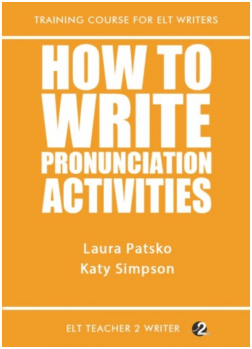
Click to find out more…

Based upon this talk and the tasks we looked at, I would highly recommend having a look at it!

IATEFL 2018 Materials Writing PCE Session 1

Here I am again at a MaW SIG PCE, which no doubt, going on past experience, will not disappoint!

The theme of today is Writing for the World, based on the realisation that a lot of writers are writing for specific situations/populations with unique needs. Mainstream materials are not sufficient, so something else needs to be done. Tania gave the example of writing for aboriginal students in North America. Who are they? What do they need? How can we give them that? The PCE will be looking at situations where English is a lingua franca, writing for refugees, writing for ESOL learners (who have spiky profiles) and writing for students with special educational needs.

The first session of the PCE is by Marek Kiczkowiak, the founder of TEFLEquity Advocates:

ELF and materials writing

There is a huge problem when it comes to job ads, many still require native speakers only and tehre is a widespread belief that NS speak with the “correct accent”, have a feel for the language that NNS can’t have etc. Debatable. What is important for today’s talk is that these beliefs don’t just lead to discriminatory hiring policies but also influence how materials are written. When we write materials for EFL or ESL, we are quite likely to emphasise conformity with a standard model, there has also been emphasis on “target culture” (often British/American). This would be fine if it were like Polish, if you were learning Polish it would be because you wanted to learn about Polish culture and interact with Polish people. English however is now a global language so why would we focus on native speaker culture and norms? We need to prepare learners to use English as a lingua franca, which requires a different approach to materials writing. Such a change would help the profession move away from the damaging beliefs around NS-NNS and reflect the global nature of the language.

How can we make this transition from writing materials for EFL to writing materials for ELF?

  • What is ELF?
  • 7 assumptions behind writing materials (not an attack but a call for change, a suggestion for change, to move from writing materials for EFL to writing for ELF)
  • Three practical activities that could be included in coursebooks, could be used by materials writers.

Definition of ELF – a context where lots of people speaking different languages use English to communicate as the only common language between them. E.g. in business meetings. Business is primarily conducted in English. Also in conferences, lots of different L1’s, but English is the common language of communication. Higher education is another context, as well as tourism. ELF is a 3rd paradigm, distinct from EFL and ELF.

Assumptions:

The more native-like the pronunciation of a student, the more intelligible they will be. However: it is not proximity to NS model that makes a speaker intelligible in an international setting. It can actually make you less intelligible in a LF setting. A study took over 1300 people from 11 different countries and had to listen to recordings of different speakers, only one spoke a standard variety (American) and he was judged as least intelligible across the board (second only to one from Hong Kong).

Frequently focus on NS models of culture – British or American typical. Tomlinson and Masuhara (2013) concluded that materials predominantly focus on British or American culture. Another study found that when other cultures were introduced, it was done in a very simplistic way that resulted in stereotyping other cultures and critical reflection on other cultures was not encouraged.

The language that students were taught in coursebooks analysed by T and M, standard middle class British English was the target. However proximity to a standard model is not what makes ELF communication successful, it is particular communicative skills. A study looking at students from various countries studying in Italy, analysed 120 hours of communication, one of the communicative strategies that helped communication be most successful was paraphrasing.

We also need a wider variety of authentic non-native accents. Exposure to lots of accents helps students understand those accents. We do a good job of helping students understand standard native speaker accents, we need to extend this.

Authentic English examples are taken from corpora but they are native speaker corpora. What is authentic language for non- native speakers? Language used in multingual settings, between non-native speakers. We need to use ELF corpora e.g. VOICE, ACE, ELFA, to tap into authentic language.

If you are multilingual, you know that when you speak the language you will use words from other languages. That doesn’t mean you don’t necessarily know the word but you want to facilitate communication, or to signal identity, or it’s just easier. Marek uses Polish, English and Spanish interchangeably. At his hotel, speaking to a Polish speaker, the hotel clerk used words like checkout and checkin.

We also need to raise students’ awareness of all the issues talked about in this session, about the global nature of the English language. They don’t need to agree but it is important that they consider the issues critically.

Focus on 3 areas and 3 activities to use in materials writing

Intercultural skills

List three things that define you as an individual and three things that define the people in your country:

Me: Vegan, teacher, gay

People in this country: ???

We then had to discuss some questions which had us compare lists with a partner, see if there was anything surprising in the country lists and suchlike. The final question was: What does this tell us about culture and identity?

Promote multilingual English use

We looked at a dialogue with some code-switching in it – réunion vs meeting (building rapport?) – and parfait/buenìsmo (could be signalling identity). Shouldn’t assume they don’t know the English words.

  • In a course book in Germany – 25/29 interactions were only between native speakers of English.
  • When NNS appear in dialogues, often they are not successful ELF users, they are someone struggling to buy a ticket for example.

Marek has developed an easy to follow step by step guide for teaching and writing for ELF (see flyer – can also download the slides) – prerecorded sessions, reading suggestions, forum – with special offers for IATEFL week: plus free teaching ELF pronunciation course plus pronunciation interviews with experts plus teaching ELF interviews with experts.


Preparing for IATEFL 2018 (paragraph blogging)

I first came across the idea of paragraph blogging because Sandy Millin gave it a go and I read her blog regularly. Given I am using bullet points, this isn’t technically a paragraph BUT it is a much shorter post than I am usually given to writing, so I think that is in keeping with the general concept, one which I may revisit post IATEFL as it is about the only way I will have time to publish anything for the next couple of terms!

Usually my preparations for IATEFL include asking and answering the following questions:

  • What will I see (peruse the programme and highlight far too many things – how many can I squeeze in?)
  • Who will I see? (make plans to catch up with a bunch of people)
  • What/where will I eat? (are there any eateries that are me-friendly i.e. cater for vegans? If not, where is the nearest supermarket? Thank goodness for self-catering.)
  • How will I decompress? (Any nice spaces for walking or running to alleviate the effects people-heavy nature of conferences on an introvert?)
  • How do I get from my accommodation to the conference centre and back again? (study Google Maps and pray)
  • Who is covering my classes at work? (Make sure they have everything they need to do it easily)
  • Have I packed my data cable? (Where did I put it after the last conference???? In a safe place…)

This year, I am adding the following questions:

  • How many essay outlines can I give feedback on via Turnitin while I am at the conference? (There are up to 30 – if all my students submit – being submitted on Sunday and I have two weeks to mark them in. One of those weeks is IATEFL. The other of those weeks is one in which I will need teach all my classes, mark up to 80 listening exam scripts, or two groups worth + double marking, and do all my ADoSing duties as I have been made an ADos for this term and next term.)
  • Can I finish marking all the reading and writing practice exam scripts (x30) on the train on the way down South? If so, will there be time also to look at the conference programme and my talk (which I prepared, thankfully, late last year but need to review)?
  • How best to organise my time at the conference to maximise on good sessions, catch up with people, keep up with marking and decompress as needed (and ideally fit in some eating and sleeping too!)?
  • How much extra admin (e.g. tutorial timetables, speaking exam timetables, meeting notes, checklists, draft emails) can I do this week to save myself a few headaches in Week 3 (a.k.a. the crazy week awaiting me on my return)?

To anybody attending IATEFL this year, or to anybody who has attended IATEFL in the past, what questions do you ask and answer in preparation? 🙂