
IATEFL Web Conference: “Why we should be taking the fun out of the classroom” – Diana England

On the 22nd November 2018, I managed to watch a grand total of one of the sessions from the IATEFL Web Conference. No time to watch them all, and the title of this one really intrigued me!

Diana England works at IH – Torres Vedras/Lisbon. She starts by saying it, as in the title, sounds a bit strange but that it is about taking fun out and putting in something much more valuable. Again, intriguing!

Talk outline:

  • What fun and enjoyment mean
  • How these words are used in everyday English
  • The lures and dangers of fun
  • The science of enjoyment
  • The psychology of enjoyment
  • The connection between learning and enjoyment
  • Ideas for going beyond fun

She hopes to give us some interesting perspectives on we teach, how students learn and offer a different way forward.

What fun and enjoyment mean

Diana’s hunch was that fun and enjoyment are not the same thing. Similarities and indeed differences between them exist. She looked them up in 3 different online dictionaries: Macmillan, Cambridge and Collins. Here are the words which she italicised in the definitions she found:

  • Fun – not important or serious, amusement, diversion, gaity, merriment
  • Enjoyment – pleasure, happiness, benefit and use, possession of something satisfying and beneficial

So, both include pleasure, fun is more trivial and light-hearted while enjoyment has a greater sense of depth to it.

How these words are used in everyday English

How do we apply them in everyday English? What connotations and attitudes are inherent? Here are some examples:

Fun

  • The kids made fun of her – mocking
  • We were only having a bit of fun – trivial
  • It’s not all fun and games – negative
  • It was fun while it lasted – temporary
  • We went on a picnic just for the fun of it – random, no principle behind it
  • Time flies when you’re having fun – pleasurable experience

Enjoyment

  • Enjoy your meal
  • They really enjoyed themselves on holiday

–> more engagement

Diana couldn’t find any idioms for enjoy but the above expressions show how it is commonly used: for positive, pleasurable experiences.

The lures and dangers of fun

We then looked at things that Diana has overheard or said herself in the past, using the word fun. We should consider what the teacher’s concept of these three things is:

  • concept of effective teaching
  • concept of the process of learning
  • sense of relationships within the class

I like to start my lessons with a fun warmer.

=> Chia Suan Chong wrote an article for ETP magazine entitled warmers, fillers, what on earth – she is skeptical of the need as they may be random and of little value to the lesson. It might be “fun” but how does it relate to the programme, how does it help them learn, how effective is it?

I like using a bomb timer or random points generator when we are playing games in class.

=> It might be a bit of fun but Diana isn’t one for these kind of gimmicks, she thinks they can be potentially quite detrimental because some children might get overly excited and it might take over the language purpose of the lesson. So do they result in improved learning? Probably not.

Has anyone got something fun I can do with my teens class?

=> she is skeptical when she hears it, she wonders what is going on in the teacher’s class. Are the lessons usually boring? Is it linked to a learning objective or will any old fun thing do? Will the teacher be able to ensure that effective learning takes place? Does the teacher feel she is losing control? Does she want the students to like her? Won’t necessarily happen.

It was a good lesson, the students had a lot of fun today.

=> Does fun equal good? Maybe, maybe not. Students laughing and playing games does not necessarily make for a productive, valuable lesson.

I see myself as a fun teacher

=> is that all you are, fun? What do the students think of you? Do they think the same? Do all students have the same opinion? She’d question that. Does being a fun teacher mean you are ale to achieve better results than another kind of teacher? Should the emphasis be on the teacher or on the students and environment?

If you’re good, we’ll play a game at the end of the lesson.

=> Trying to get the students to behave and get on with stuff. So this is a carrot in terms of the carrot and stick approach. Should games be seen as the fun element of the lesson? There are other ways of having fun. And should it be a carrot/add on? They are important not just a filler you put in. Diana would sometimes say this, and even though they’d been good as gold and worked hard, time management meant that there wasn’t time to have fun at the end of the lesson. So next time, why should they bother if they know chances are it won’t happen due to time constraints?

That’s the 3rd time Sam’s done ‘backs to the board’ in as many lessons.

=> (This activity generally relates to content of previous lessons.) Why are they doing it 3 times in as many lessons? The students appeared to like it, so it makes him feel good, but doesn’t necessarily mean that effective ongoing learning is happening. Perhaps Sam wants students to like him and is putting this ahead of ensuring effective learning?

So, the lures:

  • lighten the mood
  • beneficial
  • breaking the ice
  • engaging learners
  • good atmosphere
  • raise energy levels

(from the audience)

  • They can be easy to include in a lesson
  • gratifying
  • make the teacher look cool
  • motivating
  • Teachers may think that is what students want and so they will be popular with students
  • easy to prepare
  • good fallbacks.

(from Diana)

Diana would argue the reverse. She says there are dangers => it could result in random, coincidental learning, it may be restricted to games, warmers and fillers, it may not be relevant to the course/programme, it may not suit all learning styles and may not be the best way of maximising learner opportunities. Finally, it may end up alienating students, students may get bored and demotivated, and disengage.

The science of enjoyment

Diana is arguing that there is a difference between fun and enjoyment. We need to take out the fun and put in the principled enjoyment.

The first question is, what happens in the brain to enable you to derive enjoyment?

Dopamine =>the joy of finding what you seek.”  This motivates you to take action, encourages the persistence required to seek reward and approach a goal. Dopamine release enables you to move towards the goal and another hit occurs as you hit the goal. To harness it, you need to create a series of small successes/goals. To avoid dopamine lag, you need to set new goals before you achieve the current one. What are the implications of this for us as teachers? We need to help students to set achievable goals. We should scaffold their learning – guide and help them, slowly take away our control and give them control. We need to inspire students to move from extrinsic to intrinsic motivation. We need to provide a supportive classroom environment. We need to recognise our students’ class and individual achievements and provide judicious praise. It’s not the quantity but the quality of the praise. What effort have they made that warrants the praise. Be specific! (This last bit about specificity connects with the M.A. findings that triggered the creation of our scholarship circle here! That was in relation to positive feedback.)

Serotonin => “The security of social domination”. This is the confidence molecule which flows when you feel significant or important. When you feel respected by others, you feel it and your brain tries to replicate what allowed you to experience it in the past. Remembering success produces serotonin, so does gratitude and positive thought. What are the implications for teachers? Ensure that you establish an inclusive atmosphere where everyone is equal, you value everyone, no one is demeaned. Try allocating roles to promote self esteem, be genuinely positive, bring the outside into the classroom by exploiting outside classroom experiences.

Oxytocin => “the safety of social bonds“. This is the cuddle neurochemical, which is released though closeness with another person. It helps induce intimacy and trust and build relationships. It can be triggered through social bonding such as eye contact and attentiveness. When needs are met, you get an oxytocin hit. What does this mean for teachers and students? We need to implement student-centred discovery-based interactive learning. Lessons and lesson stages need to be cooperative, constructive and take place in a caring atmosphere. Not touchy touchy feely but there can be a non-inclusive atmosphere if games are too competitive, for example, as students may feel left out. We need to enable students to enjoy each others’ successes. Help them see they are individuals but they are working towards a common goal. There should be opportunities for genuine communication, not just page turning and the language in the course book. Nominate consistently – using students’ names with correct pronunciation. Using names is important as the person feels good and noticed. Closed pair/group work is also good.

Endorphin – “the oblivion that masks pain.” This chemical is associated with fight or flight response, gives you the oomph to power through any situation. It is self-produced morphine. Laughing and stretching can cause you to release endorphins because they agitate your insides. Anticipation and expectation also increases levels of endorphins. The implications of this are: Physical movement is good when appropriate. For example, kinaesthetic activities, which use hands and bodies may be quite important. Brain breaks and light hearted moments where students can smile and have a laugh (with, rather than at, each other). We need to provide variety of activities and pace.

The psychology of enjoyment

The psychologically based definition is that enjoyment is an affective state of pleasure.

There are four concepts of pleasure:

  • flow experience: happens when people are totally involved in an activity. All of their minds and bodies are completely involved, concentration is deep, they know what they are doing and what they want to do, not worried about failing, time passes very quickly, they lose the ordinary self conscious gnawing that characterises daily life. Like “getting into the zone” We can apply this to activities in the class.
  • Cessation of anxiety: absence of negative emotional factors e.g. stress, lack of control
  • Satisfaction: positive relationship between expectation of outcomes and outcome achieved
  • Security of belonging: positive social relations leading to a sense of belonging

There are obvious links and connections between the psychological aspects of enjoyment and the scientific.

Temporaral nature:

  • in the moment: state emotions experienced in the present and refer to a specific activity or lesson
  • in retrospect: trait emotions built up over time and refer retrospectively to cumulative experience. “I really enjoy my lessons” – feelings derived not from just one activity but consistent occurrence of pleasurable activities/events.

The connection between learning and enjoyment/ideas for going beyond fun

Diana shared three ways of connecting learning and enjoyment with us.

Firstly, she told us about an action research project she did. She marked her students work based on these five descriptors – possible max of 5 for each:

CAROT

  • Content
  • Accuracy
  • Range
  • Organisation
  • Target reader

For the second piece, she kept the marks to herself, students marked each others and they used the same descriptors, then compared their assessment to my assessment and then discussed the assessment with their partner. Involving them in the whole area of evaluation of writing. They were A2+ level, so they gave feedback on the lesson in Portuguese. The feedback was very positive.
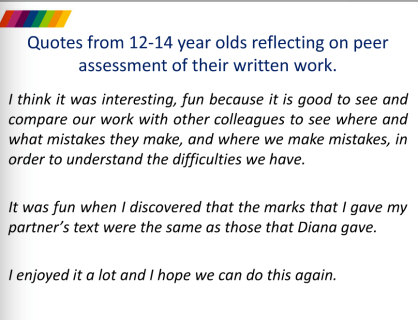
 

She also suggested that we could change boring activities into “fun” by making them enjoyable, engaging and beneficial. We need to look out for the enjoyment learning potential rather than assuming boring and compensating with another “fun” activity Working in pairs and doing transformations that practice non defining relative clauses could potentially be boring.
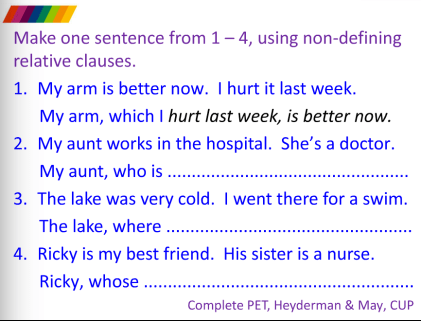
This is what Diana did:

Get students to work in pairs, they do the sentences, check the answers together as a group. Then get the students to test each other. Pair AB. Student A’s look at the board and say the first sentence in each pair. Student B is not allowed to look at the board/notebook/coursebook. They have to listen to student A and do the transformation. They need to use exaggerated intonation to emphasis the additional “interesting” information. Then they swap roles.

Finally, she shared an activity she did with a higher level group.

Higher level group – put words on the board from CB:
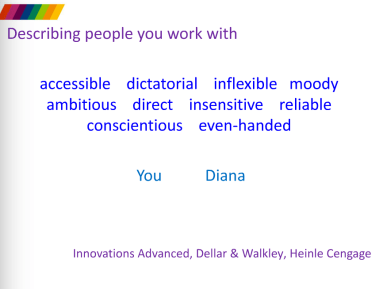
Teacher says, “I bet there are 4 words here you will mispronounce.” Students, in pairs, go through the words and discuss how they think they are pronounced in terms of sounds, wordstress and weak forms. They could be words met earlier in the unit/course or new words. Next you play beat the teacher. They all play against you. The teacher nominates a student and if they say it correctly they will get the point. If they make a mistake, T gets the mark. There is competition but it is not against each other but against the teacher and they have had a chance to work in pairs first so no one is put on the spot. By scaffolding the staging carefully, they should do well. Thus, this activity is biased for their success.

What aspects of the science and psychology of enjoyment do these activities include?

  • Scaffolding/micro-staging managed carefully: helps sustain the effect of dopamine as there is a clear goal that is achievable; sense of flow as less anxiety
  • Sense of achievement
  • Bonding
  • Interactiveness
  • Healthy competition
  • Positive, cooperative atmosphere
  • Inclusive
  • Creating positive bonds
  • Opportunities for genuine communication
  • Concentration is deep
  • No worry about failing
  • Group belonging

Quite a lot of things can be game-like as well, as long as they are managed in a principled way. Criteria for assessing the engagement factor of the activities you use:

Enjoyment is beyond fun:
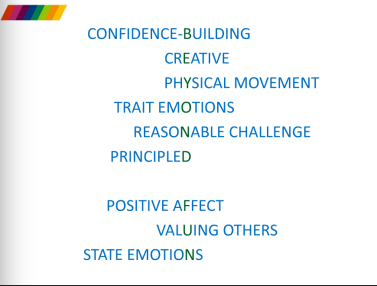
Nothing wrong with the word “fun” as long as it has a deeper, more principled sense.

It was a very interesting talk, rooted in theory, practical and most engaging. Thank you, Diana! 


Scholarship Circle: Giving formative feedback on student writing (5-8)

Last time I blamed time and workload for the lack of updates, but this time the reason there is only one post representing four sessions is in part a question of time but more importantly a question of content. This will hopefully make more sense as I go on to explain below!

(For more information about what scholarship circles involve, please look here and for write-ups of previous scholarship circles, here

You might also be interested in session 1 / session 2 / session 3 and 4 of this particular circle.)

Session 5 saw us finishing off what we started in Session 4 – i.e. editing the error correction code to make it clearer and more student-friendly. So, nothing to add for that, really! It was what it was – see write-up of Session 4 for an insight.

Sessions 6 and 7 were very interesting – we talked about potential research directions for our scholarship circle. We started with two possibilities. I suggested that we replicate the M.A. research regarding response to feedback that started the whole scholarship circle off and see if the changes we are making have had any effect. At the same time as I had that idea, another of our members brought forward the idea of participating in a study that is going to be carried out by a person who works in the Psychology department at Sheffield University, regarding reflection on feedback and locus of control. What both of these have in common is that they are not mine to talk about in any great depth on a public platform given that one has not yet been published and the other is still in its planning stages.

Session 6

So, in session 6, the M.A. researcher told us, in depth, all about her methodology, as in theory if we were to replicate that study we would be using that methodology and then we also heard about the ideas and tools involved in the Psychology department research. From the former, it was absolutely fascinating to hear about how everything was done and also straightforward enough to identify that replicating that study would take up too much time at critical assessment points when people are already pressed for time: it’s one thing to give up sleeping if you are trying to do your M.A. dissertation to distinction level (congratulations!) but another if you are just working full time and don’t necessarily want to take on that level of workload out of the goodness of your heart! We want to do research, but we also want to be realistic. With regards to the latter, it sounded potentially interesting but while we heard about the idea, we didn’t see the tools it would involve using until Session 7. The only tool that we contributed was the reflection task that we have newly integrated into our programme, which students have to complete after they receive feedback on the first draft of their assignments.

Session 7

Between Session 6 and 7, we got hold of the tools (emailed to us by the member in touch with the research in the Psychology department) and were able to have a look in advance of Session 7. In Session 7, we discussed the tools (questionnaires) and agreed that while some elements of them were potentially workable and interesting, there were enough issues regarding the content, language and length that it perhaps wasn’t the right direction for us to take after all. The tools had been produced for a different context (first year undergraduate psychology students). We decided that what we needed was to be able to use questionnaires that were geared a) towards our context and students and b) towards finding out what we want to know. We also talked about the aim of our research, as obviously the aim of a piece of research has a big impact on how you go about doing that research. Broadly, we want to better understand our students’ response to feedback and from that be able to adapt what we do with our feedback to be as useful as it possibly can be for the students. We spent some time discussing what kinds of questions might be included in such a questionnaire.

So, at this point, we began the shift away from focusing on those two studies, one existing, complete but unpublished, and one proposed,  and towards deciding on our own way forward, which became the focus of session 8

Session 8

Between Session 7 and Session 8, our M.A. Researcher sent us an email pointing out that in order to think about what we want to include in our questionnaires, we first need to have a clear idea of what our research questions are. So that was the first thing we discussed.

One fairly important thing that we decided today as part of that discussion about research questions was that it would be better to focus on one thing at a time. So, rather than focusing on all the types of feedback that Turnitin has to offer within one project, this time round focus specifically on the quickmarks (which, of course, we have recently been working on!). Then, next time round we could shift the focus to another aspect. This is in keeping with our recognition of the need to be realistic regarding what we can achieve, so as to avoid setting ourselves up for failure. (I think this is a key thing to bear in mind for anybody wanting to set up a scholarship circle like this!) The questions we decided on were:

  1. Do students understand the purpose of feedback and our expectations of them when responding to feedback?
  2. How do students respond to the Quickmarks?

Questions that got thrown around in the course of this discussion were:

  • Do students prioritise some codes over others? E.g. do they go for the ones they think are more treatable?
  • What codes do students recognise immediately?
  • If they don’t immediately recognise the codes, do they read the descriptions offered?
  • Do they click on the links in the descriptions?
  • Do they do anything with those links after opening them? (One of the students in the M.A. research opened all the links but then never did anything with them!)
  • How much time do they believe they should spend on this feedback?
  • How long are students spending on looking at the feedback in total?
  • How do students split their time between Quickmarks (/”In-text feedback” so includes comments and text-on-text a.k.a. the “T” option, which some of us haven’t previously used!) and general comments and the grade form?

Of course, these questions will feed in to the tool that we go on to design.

We identified that our learner training ideas e.g. the reflection form, improving the video that introduces them to Turnitin feedback, developing a task to go with the video in which they answer questions and in so doing create themselves a record of the important information that they can refer back to etc. can and should be worked on without waiting to do the research. That way, having done what we can to improve things based on our current understanding, we can use the research to highlight any gaps.

We also realised that for the data regarding Quickmarks to be useful, it would be good for it to be specific. So, one thing on our list of things to find out is whether Googleforms would allow us to have an item in which students identify which QMs they were given in their text and then answer questions regarding their attitude to those Quickmarks, how clear they were etc. Currently we are planning on using Googleforms to collect data as it is easy to administer and organises the results in a visually useful way. Of course that decision may be changed based on whether or not it allows us to do what we want to do.

Lots more to discuss and hopefully we will be able to squeeze in one more meeting next week (marking week, but only one exam to mark, most unusually! – in a normal marking week, it just would not be possible) before the Christmas holidays begin… we shall see! Overall, I think it will be great to carry out research as a scholarship group and use it to inform what we do (hence my overambitious as it turns out initial idea…). Exciting times! 🙂


CUP Online Academic Conference 2018: Motivation in EAP – Using intrinsically interesting ‘academic light’ topics and engaging tasks (Adrian Doff)

This is the first session of this online conference that I have been able to attend live this week, hoping to catch up with some of the others via recordings…

Part of a series of academic webinars running this week, this is the 5th session out of 8. Apparently recordings will be available in about a week’s time. Adrian Doff has worked as a teacher and teacher trainer in various countries and is co author of Meanings into Words and Language in Use series amongst other things. He is talking to us from Munich, Germany.

We are going to look at what topics and tasks might be appropriate in EAP teaching, especially to students who both need academic skills in English but also need to improve their general language ability. For most of his ELT life, Adrian has been involved in general ELT as a teacher and materials writer and has recently move into EAP mainly through supplementary material creation.

Our starting point for this webinar: look at some of the differences between GE and EAP. In the literature of EAP quite a lot is made of these differences, partly as a way to define EAP in contrast to GE.

Firstly, the contrast between needs and wants: to what extent do we define the content of the course in terms of the perceived needs of learners and what we think students want to do vs what they need to do. In all teaching and learning there is a balance between these two things.

  • In GE, needs/outcomes define the syllabus, skills and general contexts and they are seen as fairly longterm outcomes and goals, often expressed in terms of the CE framework. E.g. language used in restaurants/cafes, we think it will be useful for learners of English. Equally we consider what students want, and the topics and tasks and texts are more based on interest, engagement and variety. E.g. a common classroom activity is a class survey mingling and asking questions and reporting back. They are not really related to the needs, i.e. we don’t expect students to get a job doing surveys, but it is interesting, lively, generates interaction etc so it is motivating for them to do.
  • If we think about EAP, the needs are more pressing and clearer, dictate the skills, genre and language we look at and that dominates choice of topics, texts and tasks.

Two differences come out of this first one:

  • Firstly, In GE, the overt focus of the lesson is focused on a topic, while in EAP the overt focus is on the skills being developed.
  • Secondly, teachers’ assumptions about motivations in class.

Adrian shows us a quote from De Chazal (2014), saying that motivation is teacher-led while in EAP stakes are high and students are very self-motivated, clear intrinsic motivation from a clear goal. In GE students may not necessarily see tasks/topics relevant in terms of what they need, while in EAP they do.

Next we looked at example materials from GE and EAP, based around the same topic area of climate change.

  • EAP – “Selecting and prioritising what you need”  – students are taken through a series of skills: choosing sources, thinking about what they know, looking at the text, looking at language of course and effect, leading into writing an essay. The assumption is that students will be motivated by the knowledge that they need these skills. The page looks sober, black and white, reflecting the seriousness of EAP.
  • GE – Cambridge Empower, also leads to writing an essay but first there is focus on the topic, listening to new items about extreme weather events and discussion. Then reading a text that leads into writing skills focus on reporting opinions and it leads into the essay. It arouses interest in the topic through: strong use of visual support, active discussion of the topic, listening and speaking tasks used although it’s a reading and writing lesson. Lots of variety of interaction and general fluency practice.

These reflect the different needs of GE and EAP learners, reflects the more serious nature of academic study. This is fine if we can assume that learners in EAP classes are in fact motivated and have a clear idea of their needs and how what is being done relates to that. De Chazal uses “can be self motivated” and “are more likely to be working towards a clear goal” – not definite.

Adrian puts forward a spectrum on which GE, GEAP and SEAP on it but says that many students occupy a place somewhere in the middle of the scale i.e. learning English for study purposes but also need GE and may not have clear study aims. E.g. Turkey. Students who study English in addition to their subject of study in University context. Need to get to B1+, preparing for a programme where some content is in English but not wanting to study in an English-speaking university so don’t need full on EAP, may not necessarily be motivated. In the UK, students need an improved IELTS score, need EAP skills in addition to general skills and are more motivated. In both of these, EAP ‘light’ may be useful.

For the rest of this session, he says we will look at what this might look like and how it might come out in practice. It is clearly possible to focus on academic skills in a way that is engaging for learners who may not be highly motivated while still providing the skills that they need to master.

Approach 1

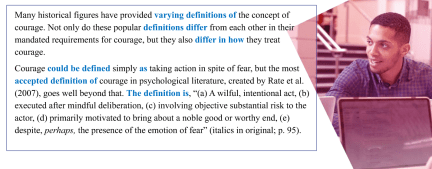
E.g. Skills for writing an academic essay, specifically in the opening part, the introduction, where they may need to define abstract concepts. Students might be shown an example which provides examples of the language needed.

It isn’t in itself a particularly engaging text, but it seems to Adrian that there are ways in which this topic could be made to be more interesting and engaging for less motivated students:

  • a lead-in to get ss thinking about the topic – brainstorming
  • discussion with concrete examples e.g. in what ways mght courage be an asset in these occupations
  • personalisation: think of a courageous person you know, what did they do which was courageous
  • prediction: get ss to write a definition of courage without using a dictionary

THEN look at the text.

So this is an example of bringing in features of General English methodology into EAP. This helps to provide motivation, it is generated by the task and teacher, bringing interest to the topic which does not HAVE to be dry.

Approach 2:

To actually choose topics which have general interest even if not related to learners’ areas of study.

Listening to lectures: identifying what the lecturer will talk about using the signals given (EAP focus: outlining content of a presentation). Can be done with a general interest topic e.g. male and female communication.

  • Start off with a topic focus: think about the way men or boys talk together and the way women or girls talk together. Do you think there are any differences? Think about…
  • Leads into a focus on listening skills: students listen to an introduction to a class seminar on this topic; identify how speaker uses signalling language, stress and intonation to make it clear what he is going to talk about

So those are a couple of examples of directions that EAP light could take. This is a crossover between GE and EAP, skills and language defined by needs, but the initial focus is on the topic itself rather than on the skills. Topics selected as academic in nature but have intrinsic interest. Motivation is enhanced through visuals, engaging tasks, personalisation etc.

Q and A

What is a good source of EAP light topics?

Adrian plugs his Academic Skills development worksheets – generally academic nature but of general interest. (They accompany “Empower”) If you are developing your own, look at the kind of topics in GE coursebooks and see if there are any that would lend themselves to EAP.

What about letting students choose their own topics?

A good idea if this is EAP where students are already engaged in academic study, as they will have a good idea of what they need. In GEAP it is important to choose topics which lend themselves to whatever academic skill you are developing as well.

What were the textbooks used in the examples:

EAP – Cambridge Academic English B2 level; GE- Empower B2 level