Scholarship Circle “TEFLising EAP” (2)

Today was the second session of our new scholarship circle “TEFLising EAP”. (You can read more about what a scholarship circle is and what it does here.) To quote from my write-up of the first session,

The idea behind this one is that EAP lessons can get a little dry – learning how to do things academically is not necessarily the most exciting thing in the world even if it is essential for would-be university students – and for the students’ sake (as well as our own!) it would be great to bring in more, let’s say ‘TEFL Tweaks’ – things that we used to do when we taught at language schools abroad (warmers, personalisation, fun activities etc!) and have got out of the habit of doing in the EAP context but that could actually be adapted for use here without losing the all-important lesson content.

Last session, we had a series of little ideas, while this session we went into more depth on two activities:

1) Synthesis Fishbowl *

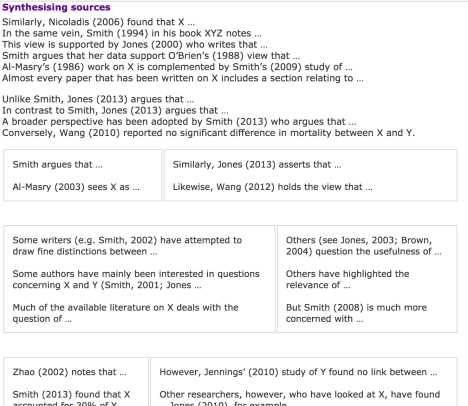
This activity takes the “fishbowl” approach to structuring a speaking activity and uses it as the basis for teaching students about synthesis. Synthesis is basically the process of using and combining multiple sources to support a point, showing where the sources agree and disagree. Linking language and particular reporting structures help the writer to do this. Here is an example of the kind language that is used in synthesising sources, taken from Manchester University’s  Academic Phrase Bank:

So now that we know what synthesis is, back to the fish bowl. In a fish bowl speaking activity, students sit in two circles, an inner circle and, around the outside of that circle (funnily enough), an outer circle. (As per the picture below, assuming that each X represents a student!)

Inner circle students face each other. They will be the speakers. Outer circle students watch the inner circle. They will be listener/note takers.

Each student/speaker in the inner circle receives a piece of paper like this:


On it they write their surname and a (fairly recent) year e.g. 2014.

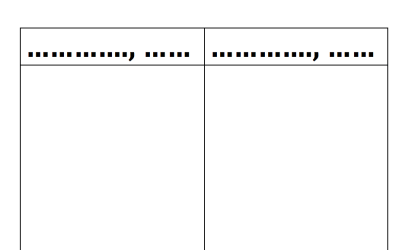
Each student/listener-notetaker receives a piece of paper with a table like this on it:

The table would have enough squares for each student of the inner circle to be represented (which would usually be about 4 – you don’t want the inner circle to be too big! For larger classes break them down into sub-groups within each of which there will be an inner and outer circle).

The inner circle discusses whatever topic you set them, the outer circle makes notes on what they say. (You can make this harder if you have really good students: the outer circle could listen and take notes that evaluate the inner circle’s arguments  e.g. “Good example from X of……../Y needed more support for what he said about bla bla bla/ Z said he agreed but didn’t explain why” etc).

Once the discussion has finished/you have called it a halt, new groups are formed of a student from the inner circle and a couple of students from the outer circle. In these new groups they identify themes that were discussed and look for relationships between the pieces of information they have noted down. I.e. what do the speakers agree about? What do they disagree about? Does a speaker (or more than one of them!) build on anything another speaker has said?

After they have teased these relationships out of their notes, they write a paragraph summarising the discussion (you could use google docs for this). You could give them a framework to use for lower levels, you could feed in language you want them to use (particular verbs or structures), depending how much scaffolding they need. They will need to pick one of the themes discussed (which will provide them with their topic sentence) and then use synthesising language to summarise what was said about it.

This mirrors what they will have to do with academic sources in their writing. We (the teachers) have decided to film ourselves doing the activity in a future scholarship circle session, so that it can be used as the basis of a homework task to prepare students for doing the activity in class themselves.

*Obviously fishbowls are not only useable for teaching synthesis – they are a way of running a speaking activity so that students’ listening skills are worked as well. Of course students take it in turns to be listeners and speakers.

2) Nominalisation game

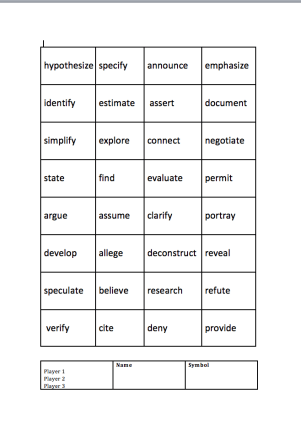
This is the game I put forward last week. This week I actually brought the grid to the session and everyone had a go at playing it. Click on the picture below to be taken to a pdf of that grid.

To quote from last week’s write up, it works like this:

Put students in groups of three and give each group a grid, counters and dice (they can use a phone app and the change in their pockets if needs be!). The aim of the game is to “collect” as many squares as possible by turning the verbs into nouns. To do this, students roll the dice and move their counter the corresponding number of moves. If their square has not been claimed, they can claim it by giving the correct noun form. If they are correct, they draw their symbol on that square. They can move in any direction that gets them to an empty square (backwards, forwards, diagonally, vertically etc) in any combination. They continue until all squares have been claimed or the teacher calls a halt. The winner has the greatest number of squares when the game stops. You can then get the students to group the nouns they have made according to the different suffixes used to create nouns and then try to think of any more verbs–>nouns they know that work in the same way.

That’s all for this week. Just like last week, the session gave me a real boost. There’s nothing like spending some quality time being creative with a great bunch of people! 🙂 Here are a few questions to leave you with:

Have you used a fish bowl activity before? How did you use it? Do you have any other ideas for teaching synthesis or activities for livening up lessons on nominalisation?


Scholarship Circle “TEFLising EAP”

Today was the inaugural session of our new scholarship circle “TEFLising EAP”*. (You can read more about what a scholarship circle is and what it does here.) The idea behind this one is that EAP lessons can get a little dry – learning how to do things academically is not necessarily the most exciting thing in the world even if it is essential for would-be university students – and for the students’ sake (as well as our own!) it would be great to bring in more, let’s say ‘TEFL Tweaks’ – things that we used to do when we taught at language schools abroad (warmers, personalisation, fun activities etc!) and have got out of the habit of doing in the EAP context but that could actually be adapted for use here without losing the all-important lesson content.

The plan is to look at the lesson materials for the following week (all of the courses here except for the highest level one have a very structured week-by-week, lesson-by-lesson syllabus and materials) and share ideas for how to breathe some life into them. We shall be doing this between 12 and 13.00 on a Friday and all in all, we will be aiming, through some most excellent collaboration, to avoid this** happening in our EAP classrooms! 😉


*not necessarily the official name!

**substitute ‘lesson’ for ‘lecture’!

Here are some of the ideas that came out of today’s session:

  1. For a listening and note-taking lesson: when you want students to work in pairs to use their notes to answer questions, make it impossible for them not to (or they won’t!) – you could do this by setting up the activity with clear stipulations i.e. one student to close their folder and one to read out the questions that they then work on together to answer. This avoids students getting buried in their folders, which is the tendency.
  2. For a citation and referencing lesson: students may be good students but may not be familiar with terminology that we take for granted, such as “semi-colon” or “bracket”. To ensure that you start the lesson with all students clear about the language you are going to use in teaching the lesson content, take that terminology (e.g. semi-colon, italics, brackets, et al etc) and use it as the basis for a backs-to-the-board game. This enables you to check that students know the terminology before you use it.
  3. A pronunciation warmer for working on minimal pairs: Minimal pairs phone numbers. Number the board vertically from 0-9 and give each number a word within which is a minimal pair sound. Here are the examples we had: 0-Annie, 1-any, 2-rise, 3-rice, 4-fool, 5-full, 6-light, 7-right, 8-sit, 9-seat. (Adapt it according to the sounds that your group of learners tend to struggle with) You read out your (invented) phone number by saying the word that corresponds with each number. So 989 would be sit seat sit. The students have to write down your phone number by deciding which word you have said and writing down the corresponding number. They can then do it in pairs. This gives them practice in both recognition and production of the minimal pairs.
  4. Do a speaking ladder at the start of the lesson based on the lesson content: It takes some time to do it, but the benefits range from giving the students (who have very long days at the college) an energy-levels boost, get them mingling, get them thinking/speaking in English and make them focus (as it generates a lot of noise, they have to listen very carefully to concentrate on “their noise”). It also gives them some bonus fluency practice.
  5. (This one was mine!) A warmer for a nominalisation lesson: Make a grid of academic verbs, one verb per square. Put students in groups of three and give each group a grid, counters and dice (they can use a phone app and the change in their pockets if needs be!). The aim of the game is to “collect” as many squares as possible by turning the verbs into nouns. To do this, students roll the dice and move their counter the corresponding number of moves. If their square has not been claimed, they can claim it by giving the correct noun form. If they are correct, they draw their symbol on that square. They can move in any direction that gets them to an empty square (backwards, forwards, diagonally, vertically etc) in any combination. They continue until all squares have been claimed or the teacher calls a halt. The winner has the greatest number of squares when the game stops. You can then get the students to group the nouns they have made according to the different suffixes used to create nouns and then try to think of any more verbs–>nouns they know that work in the same way.
  6. Academic style: When the activity requires students to edit sentences to make them more academic, here is a fun way to do it in groups. Write each sentence at the top of a blank piece of paper and make sure you have enough for each student in each group to have a different sentence. They write their edited sentence at the bottom of the sheet and fold it over to hide it. They then pass their paper to one student and take a sheet from another. Repeat this until all the students have written their edited version on each of the sentences going round in their group. At the end, as a group, they can look at all the different versions and collaborate to make a final “best version”, combining their ideas, and write that best version in their folder.
  7. Working with a text: take out ten key words, do a few rounds of backs to the board; once all words have been guessed and are on the board, get students to use them to predict the possible content of the text.
  8. Summary-writing tasks: get students to record it rather than write it for a change! Put them in pairs and give them time to make notes, discuss what they want to say and decide who will say what, then get them to record that. They can send you the recordings to listen to and give some feedback on.

The hour went by very quickly, it has to be said. Looking forward to more next Friday! 🙂 (I am planning to share the ideas here regularly but marking 30×3000 word essays [in chunks of 1 and 2000 words] is likely to get in the way somewhat! Hopefully I will catch up eventually though. )


IATEFL 2017 – In one ear and out the other: does feedback work? (Lorraine Kennedy)

You’ve got to love IATEFL Online! This year I didn’t make it to IATEFL for both personal and professional reasons; the first time since 2012 that I haven’t attended for at least some of the days. I wasn’t able to follow IATEFL Online at the time of the conference, but I think it’s marvellous that all that footage is stored for so long, giving teachers across the world the chance to access it when they are able to. As for me, finally I am addressing the “IATEFL 2017” gap that is no longer in the conferences category of this blog!

I decided to start by watching Lorraine Kennedy speak about feedback as it is something that I think about a lot in my professional day-to-day life: I am currently working for the ELTC at the University of Sheffield International College and the teaching here is focused on academic skills for students who hope to start an undergraduate or postgraduate degree in the following academic year. The academic writing strand is built on the process of drafting work, receiving feedback, reflecting on it and responding it, in order to develop sufficient skills to survive and hopefully thrive in the university environment. The question of how to improve the quality of my feedback, both written and spoken (in tutorials) is one that I continuously ask. While this talk focuses on giving feedback to in-service teachers rather than students, some of it is bound to be transferable with a little thought!

Lorraine starts by pointing out that we are all both givers and receivers of feedback. She also reminds us that feedback is prominent in the world today, so much so that we often ignore requests to give it (e.g. your hotel, the flight you travelled over on etc, all of them apparently want your feedback!). In one ear and out the other. She describes an article based on research done back in 1996 that says that 1/3 of feedback has a positive result, 1/3 has no result at all and 1/3 has negative results. So that means 2/3 of feedback has no effect or a negative effect. To Lorraine this means we need to take a step back and think about it and review our thinking on it. She informs us that Deloitte Consulting Company are trying to take performance management out of the workplace, as it isn’t working.

Her first main question is: What is the point of feedback and does anything change when we give it? We need to stop and think about some fresh questions – what will I achieve by giving feedback? Does the person I’m speaking to want my feedback? Have they requested it? How can we explore the issues that we want to discuss in feedback effectively? – and we need to start with the assumption that people will not necessarily accept feedback. Giving feedback is not by definition positive or constructive, it is just an act or a form of communication. Only feedback that is accepted is likely to have an impact. Lorraine’s focus is in-service feedback for growth and professional development.

Having raised these questions she moves on to provide a definition for feedback:
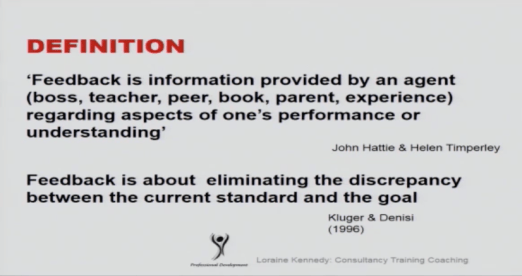
Nobody is questioning that feedback done the right way is a good thing. The Hattie definition has a broad range of providers for feedback – reading a book is a form of feedback, rather than the stricter definition of expert to novice feedback. The traditional format for feedback is the sandwich approach – good, bad, good. She wonders if it has any impact on teaching practice rather than documentation just being put in a drawer and kept for inspectors to look at. She also remembers what it was like first and foremost to receive feedback – terrifying to be observed and receive feedback on that. Then she became more confident receiving feedback and also became better at assessing herself and less bothered about someone else’s opinion. She wonders how many other people experience that. The same went for giving feedback. She was uncomfortable initially and then through becoming a coach it became a more positive experience.

Lorraine is interested in 3 areas.

1) Which is better positive or negative feedback? The research will say things like if someone is a novice, focus on their effort/commitment/progress but if someone is quite experienced, you need to be more ‘brutal’ – are you successful all the time? If not, come on, let’s look at the constructive things we should look at and focus on that. It depends on the individual, the context and whether the person is listening in the first place.

2) Mindsets – growth mindsets and fixed mindsets:
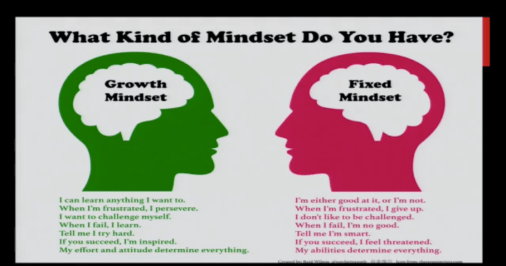
Everyone likes giving feedback to the “growth mindset” people, the fixed mindset not so much. The idea is that we should work towards developing a growth mindset in everybody. What do you do with people who have been around for a while as vs children?

3) Feedback styles – there is a lot of work out there on communication styles and feedback is one aspect of that. One of the most difficult conversations to deal with is giving feedback. How to make it palatable and make people listen? Some people like it direct, no touchy feely stuff, some are the opposite. But how helpful is that? We can’t read other peoples’ minds to know if they are open to feedback and what style they appreciate unless we know them very well and even then they may change depending on the day.

Lorraine puts forward the following:
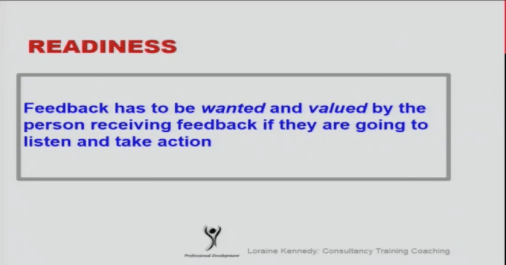
If it is unwanted or not valued, perhaps you are wasting your time. So the starting point is to be with the receiver mentality and think how does the receiver want feedback and who from? Perhaps it is not you.

She then makes some suggestions:

  • remove the word feedback from the language – has negative connotations and teachers tend to become weary of receiving it. “Really? Am I still not good enough? Do I still have to prove myself through an observation?” Instead, talk about “insight” into working performance – as a more neutral/positive term/concept.
  • use a coaching conversation technique. It doesn’t matter if you are the boss or a peer, this approach dictates that the person who has been observed takes the lead. The assumption is that if they are engaged and leading the conversation, then they are much more likely to engage willingly in that professional conversation. It could be “what would you like to talk about? what aspect of your development would you like to discuss?” (This does not apply to substandard performances but people who are well-established in the establishment).
  • coaching should lead to mentoring: the conversation should lead to your input as “giver of feedback” being requested e.g. “what would be your one suggestion to improve what I have done?” to which you could respond: “which bit would you like me to focus on?” So it is specific and requested by the individual.
  • more self-assessment should be used, so that teachers can start to lead on their own self-assessment more (performance management or observations). Very little need to tell people what to do different For this to work you need SMART objectives and it needs to be clear how progress is being measured/looked at. Encourage people to watch other people so they have benchmarks and point of comparison.
  • explore teacher beliefs about teaching and learning: it’s an important place to start. What is good classroom management? How do teachers teach well? What is a good teacher? What is effective learning? When you start with these kinds of questions you find common ground or differences of opinion to build the conversation, so that you know what perspective they are coming from and how to reach them.
  • focus on development not evaluation: if people are developing then quality results and evaluation will happen. Development is a better starting place. Goal-setting is a priority – future focus not past focus and goals need regular review. Takes the emphasis off process and puts the emphasis on results. Focus on how to impact positively on student progress and confidence? View the principles of teaching through that lens.
  • a variety of observation practices: video, audio, camera focused on the students, followed up with a coaching conversation is also valuable. Peer observation is also valuable but only when it is well set up and when people doing observations have been trained in having the post-observation dialogue. People do appreciate professional dialogue with their peers and also from managers who take the role of a peer.
  • encourage teachers to get feedback from students directly: what worked for you today? what did you find challenging? what would help next time? Five minutes at the end of a class. You can make it more formal if you wish. If we can get teachers to engage with student feedback then you won’t need to go through the managers – the teachers can report to the managers what they are learning from the students. It should be a regular part of teaching and learning.
  • establish learning culture led by teachers: creating collaborative opportunities, positive culture of growth and development. (I think my workplace does this well, with teacher-led scholarship circles)

In conclusion:
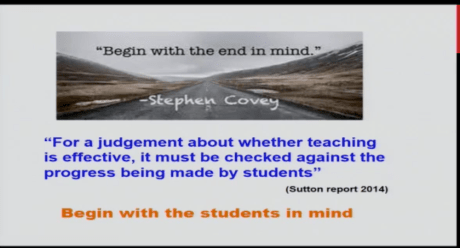
The progress being made by students doesn’t just mean results or what students got in a test, but many useful formative mechanisms in place to look at effort, confidence, support, growth, engagement etc.

Lorraine finally changes Stephen Covey’s quote to: “Begin with the students in mind” when you think about feedback in that line, greater impact on teaching and learning will result.

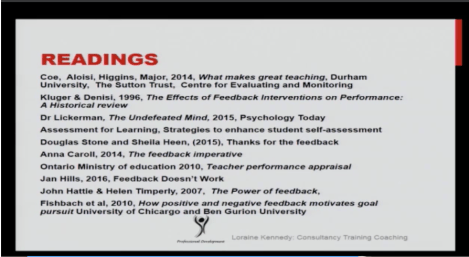
Here are the references she used:
Just a reminder that you can watch the full talk here.

I found this a very interesting talk and while it is focused on in-service teacher development, I wonder how I could incorporate some of what she has discussed into the feedback tutorials I have to give students based on their academic writing. As I said at the start of this post, I have done a lot of thinking about feedback, and giving feedback, since I have been working here and giving it on a fairly regular basis.

I think the process of reflecting each time on what I do, and what I could do differently, has helped me improve a bit each time. Partly I have become more confident about delivering the feedback (mirroring what Lorraine said) and so rather than being nervous I enjoy the experience of working with the students to help them improve. This is connected with increased confidence in being able to identify key areas for students to work on, that will have the most impact on improving their academic writing, and point them towards resources to help them with those. I know I used to give too much feedback initially, out of a desire to help the students as much as I could, such that it was nigh on impossible for the students a) to take it all in and b) to respond to it all in the time frame available to them. I think both the quantity and clarity of my feedback – or feed-forward if we must – has improved in this respect. Students receive the written feedback in advance of the tutorial, so they have time to look at it before they come and see me. To capitalise on this, where I used to launch straight into what I wanted to say, I now start the tutorial by asking the student if they have any questions about the written feedback or if they have any issues with their writing that they particularly want to discuss with me. Nine times out of ten, they do. Hopefully once these are dealt with,  this means they are more receptive to the rest of what I have to say and are less distracted by what they may have been worrying about up till that point. 

This term I intend to read up on and implement relevant coaching conversation techniques in my tutorials, to see if I can continue to increase their effectiveness for my students. I suspect there may be more posts in future relating to feedback!

Questions for you, if you got this far: 

  • How do you feel about giving feedback?
  • What kinds of feedback do you have to give in your job?
  • How has your style of giving feedback changed over time?
  • How would you like it to change in future?
  • What resources have you found useful in helping you with giving feedback? (Blog posts, journal articles etc)

(Feel free to pick out any of the questions that interest you and ignore the rest, or answer them all, whatever suits!)


The Eaquals Framework for Language Teacher Training and Development and its companion the E-Grid

In Kirsten Holt’s IATEFL 2016 talk, (yes, 2016 – yes, this post has sat as a draft in my posts box for rather a while now! Better late than never…) she makes reference to the Eaquals Framework and its companion the e-grid. I was immediately curious so thought I would try the e-grid, which generates your ‘professional profile’. The profile produced is not saved on their website, it just creates a soft copy for you to keep on your computer.

After completing fields for name and address, and employer name and address, the next step was language proficiency:

Screen Shot 2016-05-18 at 11.53.47

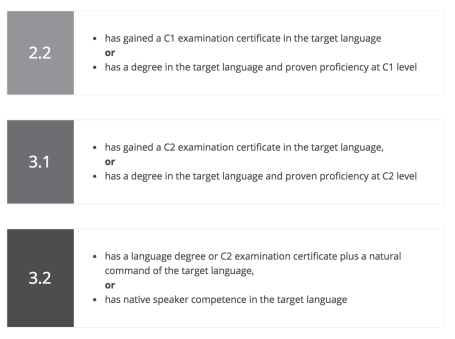
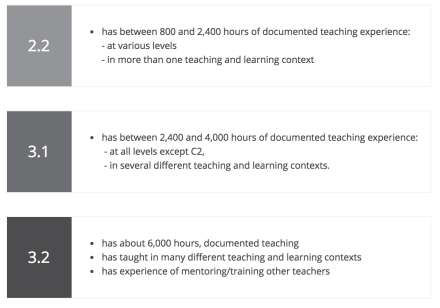
You pick your level starting from 1.1 (studying the target language at tertiary level, achieved B1 proficiency in the target language) up to 3.2 (see picture above) My questions:

  • I have a degree in the target language, two actually, but I don’t have proven proficiency at C2 level as I have never done a proficiency test.
  • What is this “natural command” that differentiates between 3.1 and 3.2? How is it measured?
  • “has native speaker competence” = 3.2 but all levels below that focus on language proficiency only for people who have learned the language in such a way that certification and examination has been part of it i.e. not people who have grown up speaking it as their mother tongue. So there are 6 levels you can pick but if you are a “native speaker”(definitions and implications of which term are another can of worms) you are automatically assigned the highest level, level 6, aka 3.2…  Are all “native speakers” equally proficient? “Proficiency” can be defined as a high degree of skill or expertise. Do all “native speakers” have that to a uniform level – in this case 3.2? (NB later in the self-assessment language awareness is dealt with separately.)

My next ?? moment came in the teaching experience question:

Screen Shot 2016-05-18 at 12.01.42

I have no idea how many hours I have taught. Also:

  • What does it mean by documented?
  • What would happen for the teacher who meets the 3.2 criteria but happens never to have taught at C2 level? Or does lack of C2 level stop mattering after 4000 hours of experience?
  • What happens if you have between 2400 and 4000 hours of teaching experience including classes at C2 level?
  • What if your 2400 – 4000 hours of experience all happen to be in the same place?

I actually did keep a record of the hours I taught and to which class in my first year of teaching. Unfortunately, I have no idea where that document is. It was several computers ago and seems to have got lost in the mists of time… I probably don’t have squillions though, given I only started 7 years ago, spent one of those years doing my Delta and M.A. full-time so only taught once a week during the Delta and some part-time work later in my M.A., worked part-time between October 2015 and March 2016 and though full-time now, have a relatively small number of contact hours per week with my groups. (What do you do the rest of the time, I hear you ask? Well, there is also cover, Writing Advisory Service sessions and at certain points, megatons of marking – 2000 – 3000 word essays rather than 250 word essays… and – woohoo! – CPD!) Then, I’ve taught C1 but not C2. Am I a 2.2? A 3.1? Is x hours of teaching the same level of experience regardless of what development has taken place alongside them? In other words is it quantity over quality?

Once you’ve finished doing the self-assessment, you can export the results as a PDF, bearing in mind it will not be saved on the website itself. You can also export the results in e-grid format, which you could later re-upload to the website and edit. So, having used the E-grid, it was time to look at the framework itself. On the website, the main aims are set out as follows:

to help practising teachers to assess and reflect on their own language teaching competences, and set their own goals for further development


to help managers to identify training needs and plan professional development programmes for practising teachers

to encourage teachers to continue their professional development on their own and with the support of their institutions

to help document the design of public training courses for practising teachers


to serve as a tool for evaluating and accrediting teacher training courses.

There is then a link to the framework, a 42 page document, which you can download and peruse at your leisure. The framework divides teacher development into 3 phases, and assumes that teachers can be in different phases of development for different skill areas. The phases don’t map to seniority of position. There are five main areas each with different sub-sections. Each of these key areas is broken down into “knowledge of” and “skills”, so theory and practice. I am assuming that the 1.1 – 3.2 in the e-grid relate to the three developmental stages in this framework, although on the E-grid webpage, it says descriptors cover six developmental stages.

Have you used this framework to help you develop? Have you used it to help other teachers develop? How did you do it? Please share your ideas with me and others by using the comments box below – you are also very welcome to use it for answering any of the questions I have raised in this post or just any related thoughts! I will share my ideas for using it in a later post. Meanwhile, don’t forget to have a look at Kirstin’s ideas as disseminated at IATEFL 2016.