Mental Health in ELT

“Mental Health” (Pixabay)

Yesterday I read a Guardian article stating that the number of referrals to mental health crisis teams in the NHS has gone up by 60%  in the UK. It didn’t seem to specify the time period in which this increase has taken place, but nevertheless it’s clear that mental health problems are something that a lot of people face to varying degrees of severity. Another recent article argues that in adopting the new GCSE result grade scales, schools are putting elite performance ahead of pupils’ wellbeing while yet another discusses the increase in mental health issues in students at university, with the number of drop-outs being three times higher in 2014-2015 than it was in 2009-2010. The context of education can be, by its very nature, a very pressurised situation where the stakes are high and failure unthinkable, even for children as young as six years old. Meanwhile, the Independent reports that at least one tenth of the 4908 teachers questioned rely on anti-depressants to combat work-related stress. An interesting initiative responds to the issue of pupil mental health at schools by proposing to give teachers the training they need to be specialists in mental health. I would argue that everybody involved in the education system – students, staff, managerial staff – would benefit from greater awareness of (potential) mental health issues, how to recognise them and how to address them.

Within education, mental health can be considered from three main angles: pupils/students mental health and mental health awareness, teachers’ mental health and mental health awareness (both of their own, colleagues’ and their students’) and managers’ mental health and mental health awareness (both of their own, their colleagues’, that of their staff team, and that of the students in their school). That’s a lot of mental health awareness needed, and alongside it, systems both for dealing with the problems that arise and, importantly, addressing the causes in order to bring down the number of these. I think this applies as fully to ELT as it does to ‘regular’ teaching, whether teachers are based in the primary, secondary and tertiary sectors or whether they are based in private language schools. All contexts are high stakes in various ways, demanding in various ways and potentially conducive to mental health issues in the staff and students within them. Universities often have support services within which students and staff can seek help if they are struggling but this relies on people a) being aware that they are struggling more than is ‘normal’/need help b) knowing how to access that help and c) not being ashamed to access it.

Looking  back on my own experiences of poor mental health, the requirements stated above are not necessarily easy to meet. If you are struggling, you are generally too focused on trying to keep your head above water, in one or multiple contexts, to see the bigger picture. Things accumulate, build up, things that each individually by themselves may be minor but in combination become more difficult to overcome. For example, at one school I was working at, I was told that I had had some complaints from students in one of my classes. It eventually transpired that there was a mismatch between their current syllabus and their expectations based on the syllabus of the previous level they had studied. However, between the issue arising and being resolved, my confidence took a massive hit. This spilled over into my personal life, as I lost confidence in my linguistic abilities too, meaning that when my gas bottle ran out, and I had to phone the service for obtaining a replacement, instead of it being a little thing and easy to do, it was a difficult thing and I couldn’t face it. So I didn’t. Which meant that I then wasn’t eating particularly well as I couldn’t cook. I was also having issues with my social life that were making me very unhappy, details unnecessary. I reached a point where I would sit in my flat in the morning feeling physically sick at the thought of going into work (and this ‘work-dread’ anxiety took a while to ease/wear off even after I changed jobs due to my contract reaching its natural end.) While all of this was going on, there was a workshop that required me to use the language I had lost confidence in, and as a result of all the issues described (which I just had to resist the temptation to qualify with “silly”!) I didn’t participate properly. This led to me being hauled into the DoS’s office for an explanation. I was asked if everything was ok, but my automatic reaction was to say yes. (I don’t know about anyone else, but that tends to be my knee-jerk response, almost a defensive one, but also what was wrong was all ‘little things’ that I was ‘dealing with’, it didn’t occur to me to talk about them when asked what was wrong.) So then I was told off, which shocked me into ending up in floods of tears explaining what was wrong and did then get the help I needed to sort out the gas etc. I think this is one example where better mental health awareness, both on my part and on my manager’s part, could have made a big difference.

Mental health, like physical health, is always in flux, is affected by what we do, what we consume, what situations we find ourselves in and other such factors. Like physical health, we need to be aware of how to manage our own mental health to avoid becoming ill and of symptoms that our health is off. Like physical health, sometimes ill health is minor and can be adjusted/improved fairly easily and other times it is a longer and more difficult process to heal. Like physical health, sometimes we need help to treat the symptoms and identify the cause. For that to happen, we need to be able to recognise and acknowledge when things are not ok with us, and we need to be able to help others to recognise and acknowledge when things may not be ok with them. Mental Health First Aid  is one interesting approach to enabling this.

“Mental Health” (Pixabay)

I don’t have the answers to it all, but it’s certainly something that I feel is important and want to explore further. To finish off this post, I leave you with Sandy Millin’s very useful post that brings together a lot of links relating to mental health and recommend that you have a look through. I also invite you to share any thoughts you have on the subject as I would be very interested to hear them. 🙂



Scholarship Circle “TEFLising EAP” (5 and 6)

Today was the sixth session of our new scholarship circle “TEFLising EAP”. (You can read more about what a scholarship circle is and what it does here.)

–  Yes, the sixth: the fifth was last week but Friday seems to have rolled round again before I’ve got round to writing it up. Life and work happened! The sixth, and also the last for this term (sob!), so a special thank you to my colleague, Holly, whose brainchild it was and who has consistently brought along interesting ideas to get the discussion going. We’ve all got a lot out of it, in terms of ideas, motivation and generally a happy Friday feeling! 🙂 

To quote from my write-up of the first session,

The idea behind this one is that EAP lessons can get a little dry – learning how to do things academically is not necessarily the most exciting thing in the world even if it is essential for would-be university students – and for the students’ sake (as well as our own!) it would be great to bring in more, let’s say ‘TEFL Tweaks’ – things that we used to do when we taught at language schools abroad (warmers, personalisation, fun activities etc!) and have got out of the habit of doing in the EAP context but that could actually be adapted for use here without losing the all-important lesson content.

Session 5

Last week, the focus of the session was how to make students more aware of what words they can and can’t use with countable and uncountable nouns – to try and minimise, amongst other things, the number of instances where we see “These research show” and “Many research prove” etc. This sequence was adapted from Teach This 

We began with a variation of backs to the board/jeopardy:

To start with, there was nothing on the board except the score table. The teacher writes a word on the board, e.g. spare key. In order to get their team member whose back is to the board to guess the word, the students have to ask a grammatically correct question, e.g. “what do you give to your neighbours so that they can water your plants while you are on holiday?”. Rather than erasing the word to write another, the word is left on the board and another is added, either underneath it or in the column next to it. Obviously one of the columns is for countable nouns and one for uncountable nouns.

Once the game is finished, the teacher then elicits from the students what each column of words is (countable/uncountable) and what question you could ask about each (How many…? or How much…?) Students should then work in pairs and identify one similarity and one difference between them, using these questions. So, student A might ask “How many tattoos do you have?” and Student B might reply “2”. Student A would either say “me too!” or “I have ten” or “I have none” and that would be a similarity or difference, depending on the response.

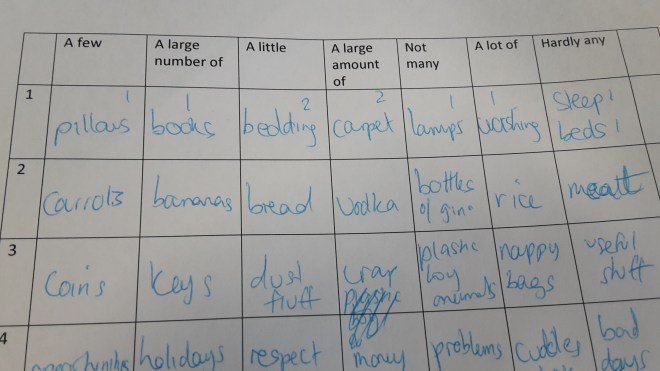
Next, students brainstorm quantifiers that can be used with each column (or you can give them a list of quantifiers and get them to match which ones go with which column). Then the teacher hands out an empty grid of quantifiers per pair or group of students:

What now follows is a few rounds of Stop the Bus! In other words, the teacher gives the students a category (e.g. no. 1 above was “Things you might have in your bedroom”) and students have to write nouns that fit the category and go with each quantifier.  After each round, do some whole class feedback to make sure groups have correct words. (Be aware, a teacher, I mean a student, of course, from one group might argue rather tenaciously against a word given by another group 😉 )

Once you have done a few rounds of Stop the Bus, write up a few examples from groups’ tables.

E.g.

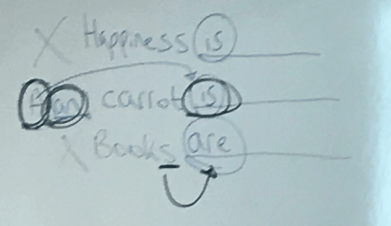
  • happiness
  • carrot
  • books

Elicit a correct example definition for each and use it to review what words are and aren’t used with uncountable, singular countable, plural countable.

In the case of our EAP classes, this whole sequence then leads onto editing their coursework writing: students choose four nouns that they have used repeatedly (e.g. research!!!!) and use the ‘search’ function in Word to find all the occurrences and check the grammar around them. They should check if the noun is countable or uncountable, and if the noun is countable they should think about whether they want it as singular or plural. The grammar around the word is then edited accordingly.

Session 6

Today, we started by looking at Getting to know you activities: the current term is drawing swiftly towards its conclusion and the new one will arrive sooner than anyone might think, so this was a bit of forward-thinking.

So, here are the ideas that were shared.

Find that person

  • Each student writes one thing about themselves on a small piece of paper and screws it up.
  • All the papers are thrown up in the air in the middle of the classroom.
  • Each student comes and takes a piece of paper (throwing it back and taking again if it is their own)
  • Students mingle and ask questions to find out a) who their piece of paper belongs to and b) more information about what is written.

Getting to know the teacher

Variation 1

  • Students work in pairs to write 5 questions they want to ask the teachers. Each question should be in a different grammatical tense.
  • Pairs swap questions with another pair and check the grammar.
  • Depending on numbers/time, group pairs and pieces of paper and allow a question or two from each pair or group, that you then have to answer.

Variation 2

  • Choose 6 pictures (the more obscure the better) that relate to different periods of your life and display them on the board.
  • Students discuss what they think the pictures are about and what they suggest about the teacher.
  • Students share their ideas with the teacher and bit by bit the real story comes out.

This could also alternatively be done with 6 names or years or places.

Variation 3

  • Teacher writes 3 truths and one lie (mixed up) about him/herself on the board.
  • Students have to ask questions to try and decide which is the lie.
  • Once the lie has been guessed, they can then do the activity in pairs and share their findings with the rest of the class.

Conversation starter

  • Students write their name in the middle of a piece of paper. Around it, they write the name of someone important to them, a year, a place, and something random (their choice) about themselves.
  • Students mingle and find out more about each of the things their classmates have written on their papers.

Shipwreck

This is for when you’ve done a bit of getting to know you but still have more time left and want to get students talking some more.

  • Give the students the scenario that there is a shipwreck, a lifeboat that only holds 5 people and a need to decide who is going to be allowed onto that lifeboat.
  • Give them a list of ten people (for example roles search “lifeboat ESL game”
  • They have to discuss and decide who to save
  • Extension: they have to take on that role and try to persuade the others on the ship to let them on the lifeboat (obviously creative license comes into play, they can go beyond the information on the role card!).

Survival

As above, this is for when you’ve done a bit of getting to know you but still have more time left and want to get them talking some more.

  • Linking back to the shipwreck, now that students have decided who will live and who will die, they have to decide what to take with them.
  • Give them a list of things they have on the boat, of which they can only take 5 or the boat will sink. You could include some of the things mentioned here and some random other things. (And I bet none of the students will decide to take the condom because it makes a good water bag!)

For more getting to know you activities, see my posts here and here

After the getting-to-know-you brainstorm (or what are we supposed to call it these days – thought shower or something?), we talked about self-observation. The idea suggested was that every couple of weeks you pick one of your weaknesses  (can be very simple little things e.g. instructions, board-work, getting down to student eye-level to speak to them etc.) and focus on it in all your lessons for that period of time. Whether or not you pair it with reflective writing etc was thought to be a matter of personal choice and not for everybody. Have you done something like this before?

And that was the end of our last scholarship circle for the term (because All The Marking lands next week and continues in week 9…) I will miss them!!